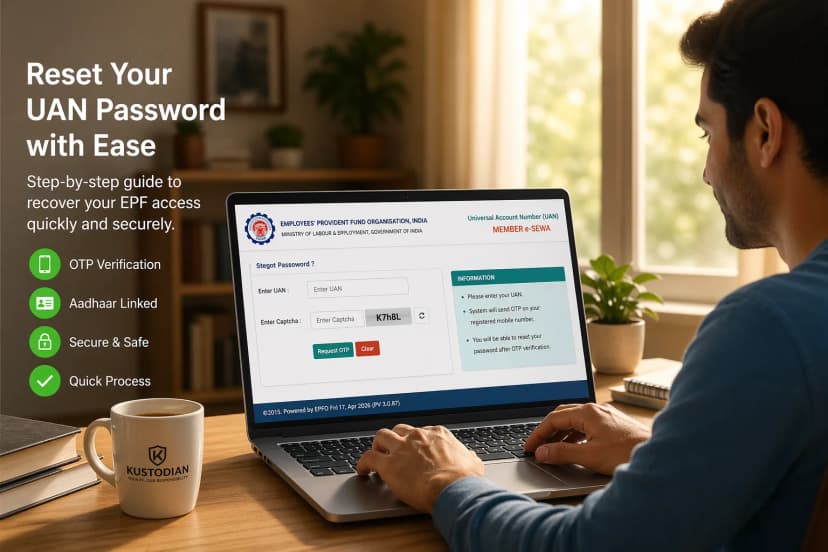
Facing EPF claim rejection due to name, DOB, or father’s name mismatch? Understand the EPF Joint Declaration Form when it’s needed, what can be corrected, and how the process works.
EPF Joint Declaration Form Explained
- What this guide covers: How to correct the name, date of birth, father’s name, and other personal details using the EPF Joint Declaration Form
- Who it’s for: Employees whose EPF claims, transfers, or withdrawals are stuck due to data mismatches
- Key reassurance: These errors are common and usually fixable
- When to worry: If claims are repeatedly rejected or employer confirmation is pending for a long time
- What to do next: Identify the mismatch first, then decide whether a joint declaration is required
When a Small EPF Error Creates a Big Roadblock
Many EPF problems don’t start with missing money; they often begin with a small discrepancy.
A missing initial in your name. A different date of birth across records. “Father’s name” is written differently by various employers.
On paper, these feel minor. In the EPFO system, they can completely stop:
- PF transfers
- Final settlements
- Pension claims
- Online withdrawals
At Kustodian, we regularly see people assume something is “wrong with EPFO” when the issue is actually a data inconsistency created years ago, often during the first job.
The good news? Most of these issues can be corrected using the EPF Joint Declaration Form when used correctly.
What Is the EPF Joint Declaration Form?
The EPF Joint Declaration Form is a request submitted jointly by:
- The employee, and
- The employer
It is used to correct personal details recorded in EPFO systems that cannot be auto-corrected online.
Why It Exists
- Older EPF records were often filled manually.
- Employers entered data before Aadhaar standardisation.
- Employees were rarely shown PF forms before submission
This form exists to reconcile those legacy errors.
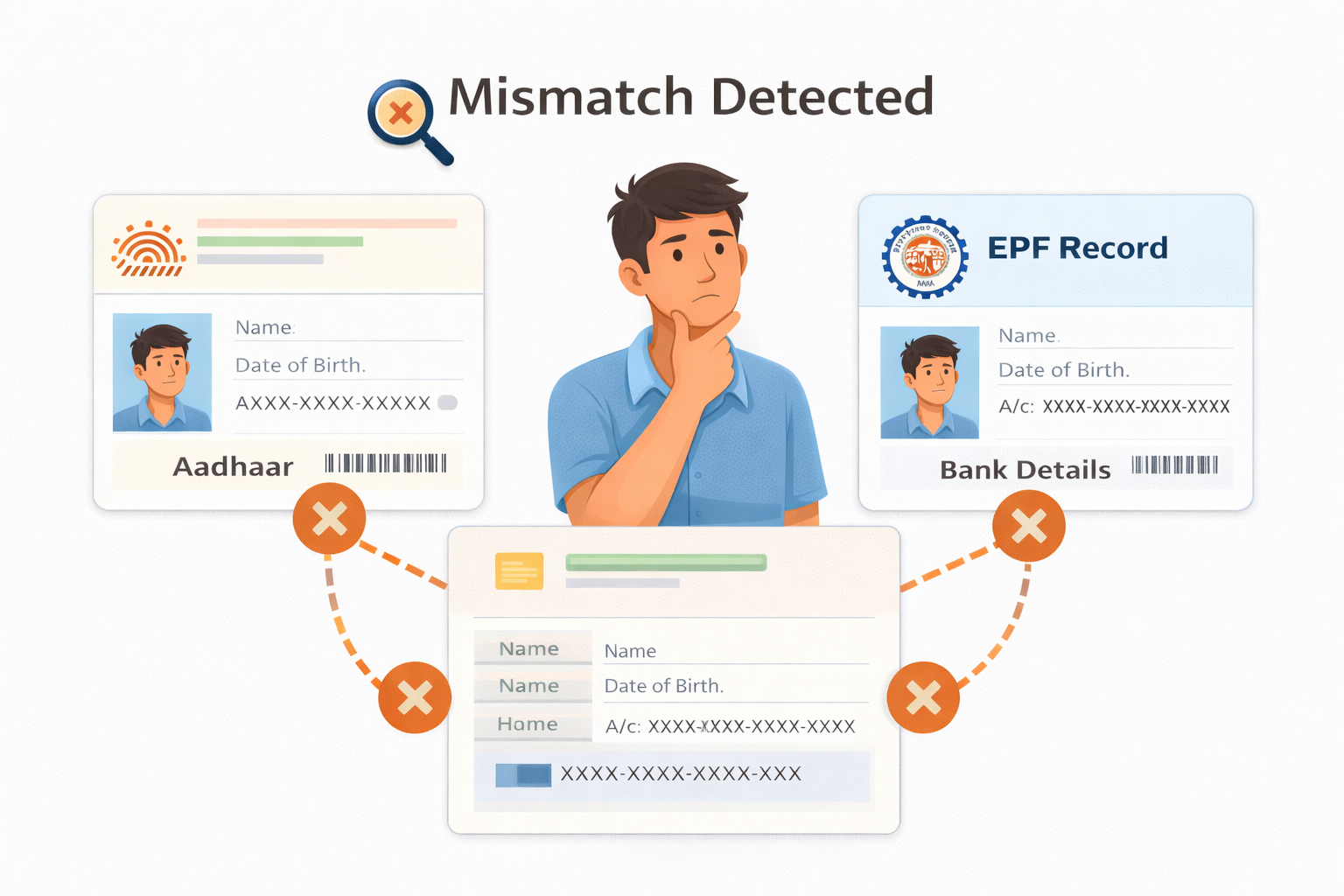
What Details Can Be Corrected Using the Joint Declaration?
The form is typically used to correct:
- Name (spelling, initials, surname)
- Date of birth
- Father’s / Husband’s name
- Date of joining or exit (in some cases)
Important: Not all corrections require a joint declaration. Some can be updated directly through Aadhaar-based KYC.
When Is a Joint Declaration Required and When It’s Not
Understanding this saves weeks of unnecessary effort.
Usually Requires Joint Declaration
- Name mismatch not matching Aadhaar.
- DOB mismatch across employers
- Father’s name discrepancy is blocking the claim.
- Older EPF accounts (pre-digital records)
Usually Does Not Require Joint Declaration
- Address updates
- Mobile number changes
- Bank account updates
- Aadhaar seeding (if name already matches)
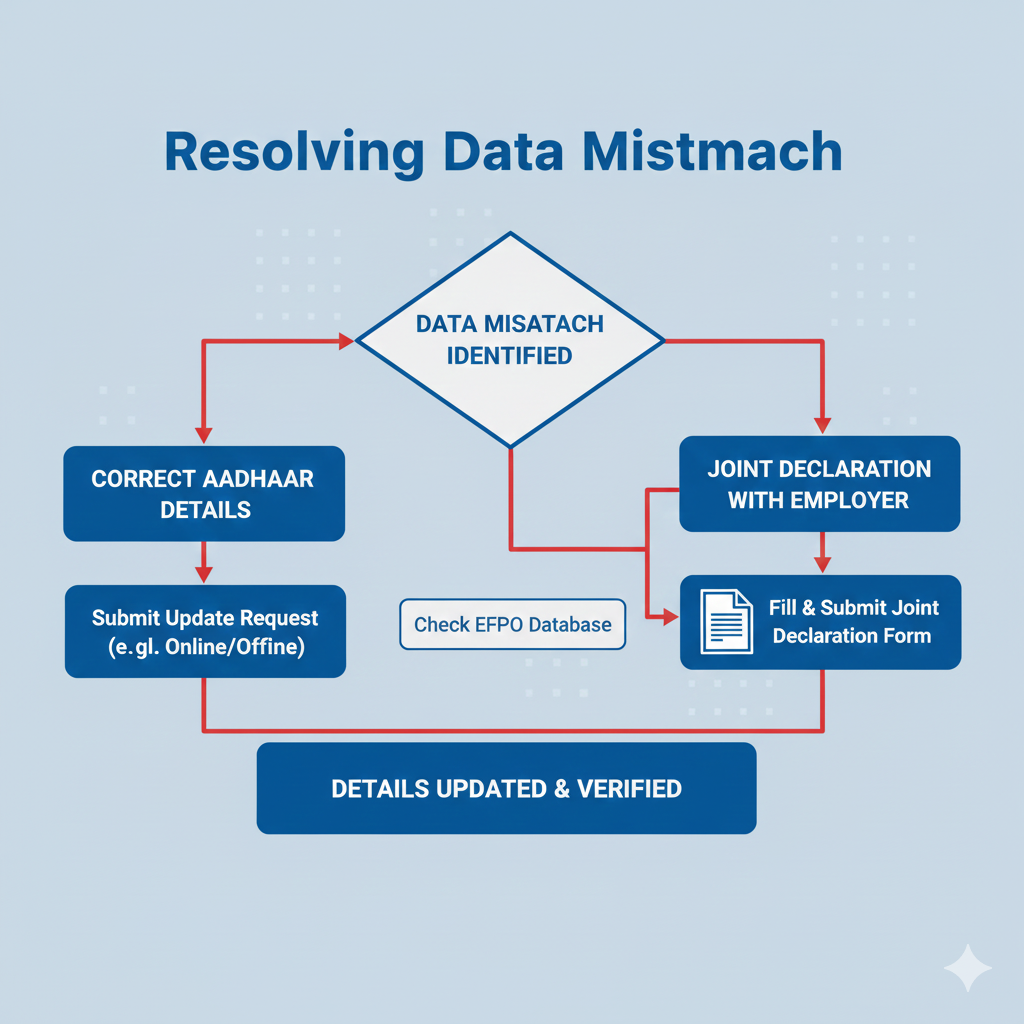
Why EPF Claims Get Rejected Due to Data Mismatch
From EPFO’s perspective, mismatches raise red flags:
- Identity verification fails
- Pension service becomes inconsistent.
- Fraud prevention checks trigger holds
This is why even genuine claims are rejected with vague messages like:
“Details mismatch” “Verification pending”
The Joint Declaration helps EPFO legally validate the correction with employer confirmation.
If you’d like a second check before filing, we offer a free EPF audit. No obligation.
How the Joint Declaration Process Works
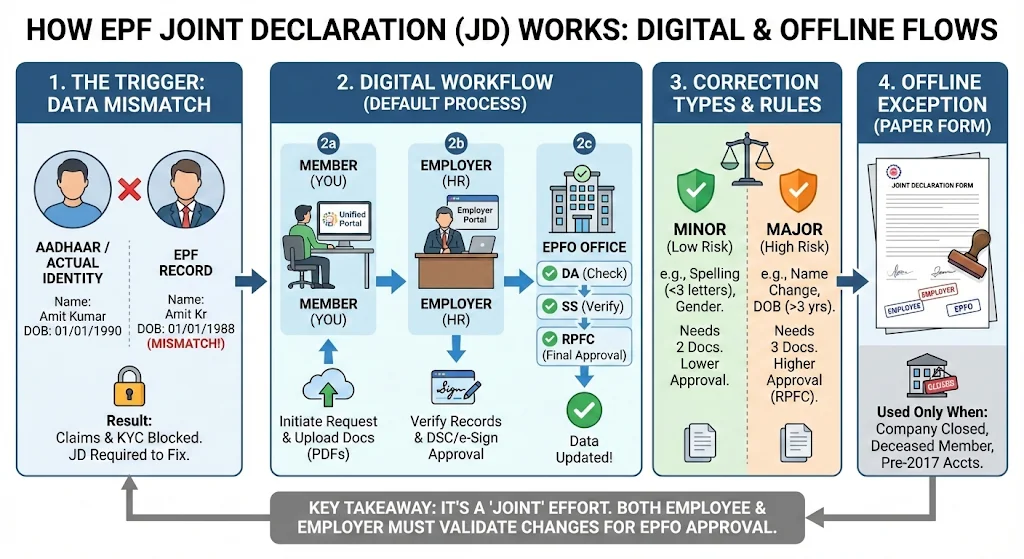
The "Joint Declaration" (JD) is the official mechanism used to correct data mismatches between your actual identity (Aadhaar/Passport) and the records held by the EPFO.
As of the Standard Operating Procedure (SOP) effective from 2025, this process has shifted from a purely manual paper trail to a digital-first workflow for most employees.
Here is the breakdown of how it works, the logic behind "Major" vs. "Minor" corrections, and the approval chain.
1. The Core Concept
The EPFO database is rigid. If your name is "Amit Kumar" on your Aadhaar but "Amit Kr" in your PF account, the system views this as a discrepancy that blocks withdrawals, transfers, and KYC seeding.
- The "Joint" Aspect: It is called "Joint" because both the employee (you) and the employer must sign off on the change. You cannot change data unilaterally; the employer must verify that you are indeed the same person they hired.
2. The New Digital Workflow (Default Method)
For most active employees, the process is now online.
Step 1: Member Initiation
- Log in to the Unified Member Portal.
- Navigate to Manage > Joint Declaration.
- Select the Member ID (if you have multiple previous companies).
- Enter the correct details (Name, DOB, Date of Joining, etc.) exactly as per Aadhaar.Upload Proofs: You must upload scanned documents (PDF) supporting the change.Step 2: Employer VerificationStep 3: EPFO Field Office Action
3. Major vs. Minor Corrections (The Rules of Evidence)
The EPFO classifies corrections into two types to prevent fraud. The type of correction determines the scrutiny level and documents required.
| Feature and and and and and | Minor Correction | Major Correction |
| Definition | Spelling fixes (< 3 letters), expanding initials, gender change. | Name change (> 3 letters), DOB change (> 3 years), and changing Father's name completely. |
| Risk Profile | Low risk of fraud. | High risk (identity takeover). |
| Proof Required | At least 2 relevant documents. | At least 3 relevant documents. |
| Approval Level | Section Supervisor / APFC. | Regional PF Commissioner (RPFC). |
4. Required Documents (The "Hierarchy")
You cannot just submit any paper. The SOP enforces a hierarchy of acceptable documents.
- Tier 1 (Primary): Aadhaar (Mandatory for almost all corrections).
- Tier 2 (Secondary): Passport, Death Certificate (for death claims), Birth Certificate.
- Tier 3 (Supporting): School Leaving Certificate, PAN Card, Driving License, Bank Passbook (with photo and cross-stamped).
- Company Records: For Date of Joining/Leaving corrections, the EPFO often relies on the Attendance Register or Appointment Letter.
5. When is the "Offline" (Physical) Form Used?
You still need the physical paper form (signed and stamped by the employer) in specific "Category C" cases:
- Closed Establishment: Your company has shut down, and no one can approve the online request.
- Deceased Member: A nominee/widow is filing for corrections to claim insurance/pension.
- Old Accounts: Accounts from pre-2017 that are not linked to a UAN or Aadhaar.
6. Common Failure Points
- Rejection at Employer Level: If you upload a blurred PDF or if the company records don't match your claim, HR will reject it before it even reaches the EPFO.
- Correction Limit: You cannot change your Date of Birth more than once in your service history without extreme scrutiny.
Note: Processing time varies by EPFO office and record age.
Documents Commonly Required
While requirements can differ slightly, commonly asked documents include:
- Aadhaar card
- PAN card
- Passport or birth certificate (for DOB)
- Employer letter (in some cases)
Common Scenarios Where a Joint Declaration Helps
Scenario 1: Name Spelling Difference
“Rohit Kumar” vs “Rohit Kr.”
Even minor abbreviations can block online claims.
Scenario 2: DOB Mismatch
One employer entered DOB as 1992, another as 1993.
This often surfaces during pension or final settlement.
Scenario 3: Father’s Name Variation
“Ram Lal” vs “Ramlal” across different EPF accounts.
How Long Does Correction Take?
There is no single fixed timeline, but typically:
| Stage | Expected Time |
| Employer confirmation | 1–2 weeks |
| EPFO verification | 2–6 weeks |
| Record update | Varies |
Delays are more common in:
- Older accounts
- Closed establishments
- Trust-managed PFs
When Waiting Is Normal and When to Act
It’s normal to wait a few weeks after submission. However, follow-up may be needed if:
- No status change after 6–8 weeks
- The employer has submitted, but EPFO hasn’t updated.
- The claim keeps failing even after the correction.
Safe escalation paths exist and should be used calmly, not aggressively.
Before escalating, confirming which detail is still mismatched helps target the issue.
Joint Declaration vs Online Aadhaar Correction
| Aspect | Aadhaar-Based Update | Joint Declaration |
| Speed | Faster | Slower |
| Employer involvement | Not always | Mandatory |
| Suitable for | Minor name fixes | Legacy / major mismatches |
| Manual verification | Minimal | Required |
Understanding this distinction avoids wasted effort.
How This Fits Into Your EPF Resolution Journey
A joint declaration is often one step, not the final solution.
It is usually required before:
- PF transfer
- Final settlement
- Pension processing
Trying to bypass it often leads to repeated rejections and frustration.
Useful Links & Official Resources
To help you verify information and complete the correction process smoothly, here are some important official portals and resources related to EPF records and joint declaration updates.
EPFO Official Portals
- EPFO Official Websitehttps://www.epfindia.gov.inThe main portal for all EPF services, circulars, and official announcements.
- Unified Member Portal (UAN Portal)https://unifiedportal-mem.epfindia.gov.in/memberinterface/Log in here to check PF balance, submit claims, update KYC, and initiate Joint Declaration requests online.
- EPFO Employer Portalhttps://unifiedportal-emp.epfindia.gov.in/epfo/Employers use this portal to approve joint declaration requests and verify employee records.
EPF Claim & Account Tools
- EPF Passbook Portalhttps://passbook.epfindia.gov.in/MemberPassBook/Login.jspView and download your PF passbook to verify contributions and account history.
- UAN Activation Pagehttps://unifiedportal-mem.epfindia.gov.in/memberinterface/no-auth/registrationActivationUAN.xhtmlActivate your Universal Account Number (UAN) if you have not already done so.
Identity & KYC Verification
- Aadhaar Official Website (UIDAI)https://uidai.gov.inUpdate or verify Aadhaar details before attempting EPF corrections.
- PAN Verification Portal (Income Tax Department)https://www.incometax.gov.inVerify PAN details if PAN mismatch is affecting EPF KYC verification.
Grievance & Escalation
- EPFiGMS – EPFO Grievance Portal https://epfigms.gov.in. File a complaint or follow up if your EPF correction or claim is pending for an unusually long time.
EPFO Circulars & Policy Updates
- EPFO Circulars & Ordershttps: www.epfindia.gov.in/site_en/Circulars.php. Notifications including updates to Joint Declaration procedures, KYC rules, and claim processing guidelines.
Frequently Asked Questions (FAQs)
1. Is a joint declaration mandatory for all corrections?
No. Many updates, like minor details, can be completed via Aadhaar-based KYC without a joint declaration.
2. Can I submit a joint declaration without employer support?
Generally no. Most corrections require employer confirmation to validate the changes.
3. What if my employer has shut down?
Alternative verification methods may be available, but timelines can be longer and may need EPFO intervention.
4. Can a joint declaration be submitted online?
Mostly offline, though some EPFO offices allow partial digital intake depending on location and type of correction.
5. Does correction guarantee claim approval?
No, it removes a major blocker, but other eligibility and verification checks may still apply.
6. Who can sign the joint declaration?
It must be signed by the employee and the current/former employer listed in the EPF account.
7. Can a joint declaration be used for bank account changes?
Yes, it can be used for critical details like bank account or IFSC corrections, but employer verification is needed.
8. How long does the EPFO process take after joint declaration submission? Processing times vary by office, usually 2–6 weeks, depending on document verification and workload.
9. What documents are required with the joint declaration?
Typically, identity proof, EPF account details, and employer confirmation are required. Some offices may ask for supporting documents.
10. Can mistakes in the joint declaration cause delays?
Yes, errors in signature, account numbers, or personal details can delay the process. Double-check all entries before submission.
Conclusion: Fix the Record First, Then Move Forward
Most EPF problems don’t mean your money is lost. They mean your records don’t match yet.
The Joint Declaration Form exists to correct history, not to punish mistakes made years ago. Used patiently and correctly, it can unblock claims that have been stuck for months or even years.
Rather than rushing into repeated claims or escalations, taking time to correct the core detail often brings the fastest relief.
Before reapplying for any EPF claim, confirming whether a joint declaration correction is needed can save significant time and stress.
Disclaimer
This article is for informational purposes only and does not constitute legal or financial advice. EPFO rules, documentation needs, and processing timelines may vary based on individual records and jurisdiction.
![Why E-Khata Applications Get Rejected in Bangalore (And How to Fix Them) [2026]](/_next/image?url=https%3A%2F%2Fwebsite-assets-wix.s3.ap-south-1.amazonaws.com%2Fimages%2Fposts%2F3031ceb9f0274289aad5c5f140be716f.webp&w=828&q=75)