When you leave a job, retire, or go through a major life transition, your EPF settlement becomes more than paperwork it becomes closure. But that closure depends on filing the right form at the right time. And this is where most people get confused.
Form 19 and Form 10C serve completely different purposes. One helps you withdraw your Provident Fund savings. The other deals with your pension eligibility under EPS. Filing the wrong form or filing both without understanding your service years can lead to panic, delays, or irreversible pension decisions.
This guide breaks down EPF Form 19 vs Form 10C in simple, practical terms. You’ll understand who should file which form, what happens if only one gets approved, how your years of service affect your pension, and how to file correctly online or offline.
Before you click “Submit Claim,” take a few minutes to understand the consequences. Because final settlement isn’t just about getting money it’s about protecting your long-term financial security.
Table of contents
- EPF Form 19 VS 10C Made Simple
- When “Final Settlement” Doesn’t Feel Final
- EPF vs EPS: Understanding the Difference
- What Is EPF Form 19?
- What Is EPF Form 10C?
- Eligibility Rules Based on Years of Service
- When Only One of Form 19 or 10C Gets Approved
- A simple example to make it clearer
- Filing Form 19 & 10C Online
- Offline Composite Claim Form: When Is It Needed?
- Typical Timelines for Final Settlement
- Common Reasons for Rejection or Delay
- Tax Implications You Should Be Aware Of
- Then Waiting Is Normal and When to Follow Up
- Frequently Asked Questions
1. EPF Form 19 VS 10C Made Simple
- What this guide is about: Explaining EPF Form 19 (PF withdrawal) and Form 10C (pension-related exit) in simple terms.
- Who it’s for: Employees leaving a job, retirees, and families handling EPF claims.
- Key confusion point: EPF and EPS are different, Form 19 and 10C serve different purposes.
- When to be careful: Your years of service decide whether you withdraw your pension or preserve it.
- What to do next: Understand eligibility first, then file the right form(s) online or offline.
- People usually file Form 19 or 10C when they’re already stretched, switching jobs, retiring, or handling paperwork after a death. That’s when irreversible decisions get made fastest.
2. When “Final Settlement” Doesn’t Feel Final
For many people, knowing EPF Form 19 vs 10C and filling it out happens at a sensitive moment, leaving a long-held job, planning retirement, or managing finances after a loss in the family. The term “final settlement” sounds straightforward, but the reality often isn’t.
At Kustodian, we regularly see confusion around questions like: “Why was only my Form 19 approved?” “What happened to my pension?”, or “Should I withdraw EPS or wait?” These doubts are understandable. EPF rules are layered, and pension decisions are irreversible in some cases.
This guide exists to bring clarity, not to rush you into withdrawal, but to help you make an informed, calm decision.
Schedule A Free Call With Our Experts
3. EPF vs EPS: Understanding the Difference
Form 19 is used for the final settlement of your Provident Fund (PF) balance, which includes your contributions, your employer's contributions, and all accrued interest. In contrast, Form 10C is specifically for your Employees' Pension Scheme (EPS) benefits.
Before looking deeply at these forms, it’s important to separate the two components of your PF account.
- EPF (Employees’ Provident Fund): Your savings account. This is what Form 19 deals with.
- EPS (Employees’ Pension Scheme): Your pension eligibility, based on years of service. This is where Form 10C comes in. (epf and eps link)
Many people assume that withdrawing PF automatically ends pension benefits. That’s not always true.
4. What Is EPF Form 19?
Form 19 is used to withdraw your Provident Fund balance after leaving employment.
Why Form 19 Matters
This form allows you to access the money you and your employer contributed over the years. It is typically used when:
- You are unemployed for a qualifying period.
- You are retiring
- You are not planning immediate re-employment
What Form 19 Does Not Do
- It does not decide your pension.
- It does not transfer PF.
- It does not close your UAN permanently.
Click to know more about Form 19
5. What Is EPF Form 10C?
Form 10C deals with the pension (EPS) portion of your service.
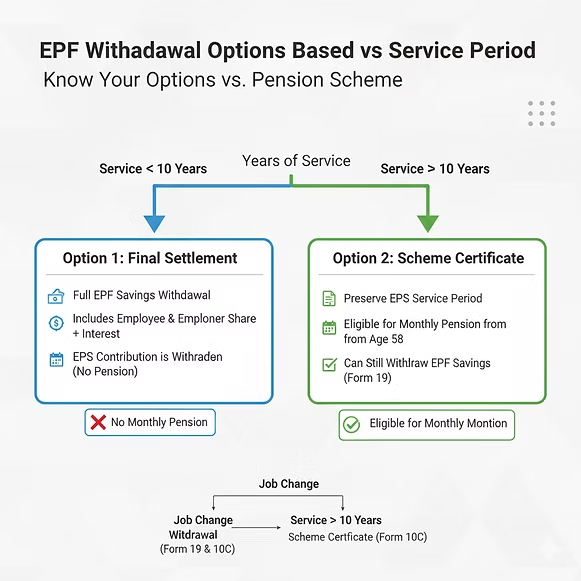
Depending on your service length, Form 10C can result in: Withdrawal benefit (if service is less than 10 years) or Scheme Certificate (if you choose to preserve pension service)
Click to know more about Form 10C.
6. Eligibility Rules Based on Years of Service
Your total EPS service is the most important factor in deciding what happens under Form 10C.
| Years of Service | What Happens Under EPS |
| Less than 10 years | Eligible for withdrawal benefit via Form 10C |
| 10 years or more | Pension preserved; no lump-sum withdrawal. |
| Age 58+ with 10+ years | Monthly pension eligibility |
Important: Once you cross 10 years of EPS service, your pension cannot be withdrawn as a lump sum.
7. When Only One of Form 19 or 10C Gets Approved
This is one of the most common concerns; the reassuring truth is that nothing has gone wrong.
When you complete 10 or more years of service under the Employee Pension Scheme (EPS), your pension becomes a lifetime benefit, not a withdrawable amount. At that point, EPFO automatically protects your pension for retirement.
So the system behaves like this:
- Form 19 approved: Your PF withdrawal is processed normally.
- Form 10C rejected, or auto-closed EPFO blocks the withdrawal because your EPS service has crossed 9 years 6 months (rounded up to 10 years). You now qualify for a monthly pension later, not a withdrawal today.This “rejection” often looks scary on the portal, but it actually means:
Your pension has been preserved, not lost, not cancelled, and not withheld due to an error.
It’s simply EPFO shifting your benefit from “withdrawal” mode to “pension for life” mode.
8. A simple example to make it clearer
Meera worked for 10 years and 4 months at her company in Bengaluru. When she resigned, she applied online for both PF and pension withdrawal.
- Her Form 19 was approved.
- Her Form 10C showed “rejected.
She worried for a moment, thinking her pension amount had disappeared.
But here’s what actually happened:
Because she had already completed more than 10 years of EPS service, EPFO preserved her pension. When Meera reaches pensionable age, she can file Form 10D and start receiving monthly pension payments for life.
So the rejection wasn’t a problem; it was EPFO confirming that her pension is secure, vested, and waiting for her future.
If you have 10 or more years of EPS service, EPFO may:
- Approve Form 19 (PF withdrawal)
- Reject or auto-close Form 10C
This is not an error. It means your pension has been preserved, not lost.
Schedule A Free Call With Our Experts
9. Filing Form 19 & 10C Online
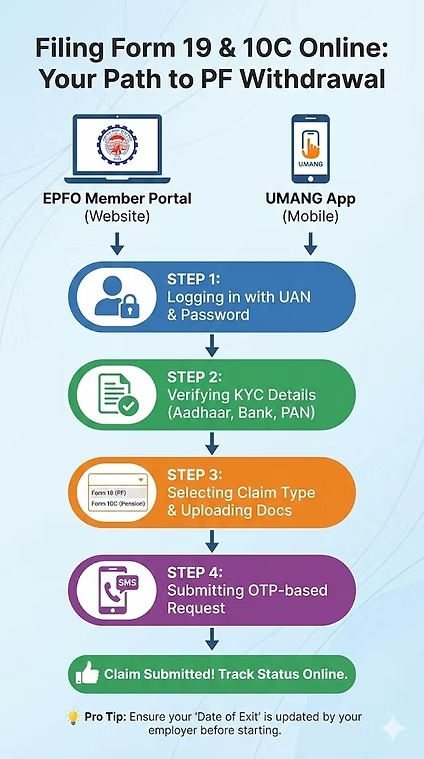
In 2026, the vast majority of EPF claims are filed digitally to ensure faster processing and transparency. This is primarily done through two main channels: the EPFO Member Portal, which serves as the comprehensive web-based platform for all member services, and the UMANG app, which provides a mobile-first interface for convenient filing on the go.
The online process is streamlined into four key stages:
- UAN Login: Members access their account using their Universal Account Number and password.
- KYC Verification: The system checks that Aadhaar, PAN, and bank details are seeded and verified to prevent rejections.
- Claim Selection: Based on eligibility, the user chooses the specific form needed, such as Form 19 for full withdrawal or Form 10C for pension benefits.
- OTP Submission: The request is authenticated and finalized using a one-time password sent to the Aadhaar-linked mobile number, acting as a secure digital signature.
10. Offline Composite Claim Form: When Is It Needed?
Offline filing may still apply if these conditions take place. It is necessary to fill the form offline in these scenarios:
- Aadhaar is not linked.
- Employer attestation is required.
- Account belongs to an exempted trust.
In such cases, a Composite Claim Form is used instead of separate Form 19 and 10C.
11. Typical Timelines for Final Settlement
| Stage | Expected Time |
| Claim submission | Day 0 |
| EPFO verification | 7–15 working days |
| Settlement credit | Within 20 working days |
Delays often occur due to KYC mismatches or employer verification issues.
12. Common Reasons for Rejection or Delay
In 2026, even minor discrepancies can trigger an automated rejection of your EPF claim. Here is a brief explanation of the four most common "bottlenecks":
1. Exit Date Not Updated
- The Issue: Your previous employer must officially record your Date of Exit (DOE) in the EPFO system. Without this, the system treats you as "currently employed," which blocks any final withdrawal or transfer request.
- The Fix: If it’s been over two months since your last contribution, you can now "Mark Exit" yourself on the Member Portal using Aadhaar-based OTP.
If you are facing issues with the date of exit or date of joining, see how to troubleshoot it effectively in this guide.
2. Name Mismatch with Aadhaar
- The Issue: The EPFO system uses strict Aadhaar-based validation. If your name has even a single-letter difference, an extra initial, or a different spelling (e.g., "Sanjay Kumar" vs. "Sanjay K.") between your PF record and Aadhaar, the claim will fail.
- The Fix: Use the "Modify Basic Details" section on the portal to align your PF records with your Aadhaar.
3. Incorrect Bank IFSC
- The Issue: Rejections often happen if you use a bank account with a changed IFSC (common after bank mergers) or an account that isn't in your name. Joint accounts are only accepted if the second holder is your spouse.
- The Fix: Upload a new cancelled cheque or passbook through the KYC section and have your current employer approve it.
4. Multiple UANs
- The Issue: If you have different Universal Account Numbers from different jobs, your funds are scattered. You cannot withdraw the total amount until all old Member IDs are consolidated under your primary (current) UAN.
- The Fix: Use the "One Member – One EPF Account" transfer tool to merge your old accounts into your active one.
Facing Multiple UAN issue? Correct with ease through this sophisticated guide.
Before reapplying, checking your EPF data alignment can save weeks of waiting. Do A free EPF Audit and check for any errors.
13. Tax Implications You Should Be Aware Of
In 2026, the taxability of your EPF withdrawal is primarily determined by your tenure of service and the documentation you provide during the claim process.
The 5-Year Continuous Service Rule
EPF is designed as a long-term retirement tool; therefore, the government offers full tax exemption only after you complete five years of continuous service. If you withdraw your balance before this milestone, the amount becomes taxable in the year of receipt. It is important to note that "continuous service" includes your tenure with previous employers, provided you transferred your PF balance to your new account rather than withdrawing it.
The Impact of PAN Linking
Linking your PAN (Permanent Account Number) to your UAN is the most effective way to manage the Tax Deducted at Source (TDS) on premature withdrawals exceeding ₹50,000.
- With a linked PAN: The EPFO deducts a standard 10% TDS.
- Without a linked PAN: You are subject to the Maximum Marginal Rate, which is approximately 34.6% in 2026.
- For those whose total annual income (including the PF withdrawal) remains below the taxable threshold, submitting Form 15G or 15H along with your PAN can help you receive the full amount without any TDS being deducted.
14. Then Waiting Is Normal and When to Follow Up
Normal waiting: Up to 20 working days after submission
Consider follow-up if:
- Status hasn’t changed in over a month.
- Employer verification is pending indefinitely.
Safe escalation channels exist, but should be used calmly and sequentially.
Useful Links & Official Resources
To help you navigate EPF claims, pension rules, and the filing process more easily, here are some important resources and official portals referenced throughout this guide.
EPFO Official Services
- EPFO Member Portal (UAN Login)https://unifiedportal-mem.epfindia.gov.in/memberinterface/Access your EPF account, submit Form 19 or Form 10C, update KYC details, and track claim status.
- EPFO Official Websitehttps://www.epfindia.gov.inThe primary source for EPF rules, circulars, pension scheme guidelines, and official notifications.
- UMANG App – EPFO Serviceshttps://web.umang.gov.inFile EPF claims, check passbook balance, and track settlements directly from your mobile device.
EPF Forms and Pension Information
- Employees’ Pension Scheme (EPS) Overviewhttps://www.epfindia.gov.in/site_docs/PDFs/Schemes/EPS95_update.pdfOfficial documentation explaining pension eligibility, service rules, and benefits.
- EPF Claim Forms (Form 19, 10C, 10D)https://www.epfindia.gov.in/site_en/Forms.phpDownload official claim forms and view instructions for withdrawal, pension certificate, and pension application.
Identity and Tax Verification
- Aadhaar Verification Portalhttps://uidai.gov.inCheck or update Aadhaar details used for EPF KYC verification.
- Income Tax Department – PAN Serviceshttps://www.incometax.gov.inVerify or link your PAN to avoid higher TDS on EPF withdrawals.
15. Frequently Asked Questions
Can I submit Form 19 and 10C together?
Yes, if you are eligible for both PF withdrawal and pension benefits. Eligibility depends mainly on your total years of EPS service.
Why was my Form 10C rejected?
Most rejections happen when the pension is preserved due to 10+ years of service.
In such cases, you become eligible for a monthly pension instead of a withdrawal.
Is pension withdrawal better than a monthly pension?
It depends on your age, service length, and long-term income needs. A monthly pension provides lifetime security, while a withdrawal is one-time.
How long does the final PF settlement usually take?
Online claims are typically settled within 10–20 working days. Delays occur if employer verification or KYC checks are pending.
Can family members file EPF or EPS claims?
Yes, nominees or legal heirs can file claims in case of death. Proper nomination and documentation make the process smoother.
What happens if my employer hasn’t updated my exit date?
Claims may remain pending until the exit date is corrected. You may need an employer follow-up or EPFO assistance to resolve it.
Can I withdraw PF if I plan to work again later?
Yes, but withdrawal may impact long-term savings and pension continuity. Transfer is usually better if future employment is likely.
Does Form 10C transfer pension service automatically?
No, Form 10C is used for withdrawal or scheme certificate, not transfer. Pension service transfers automatically with PF transfer via UAN.
What if my Aadhaar details don’t match EPFO records?
Mismatch can cause claim delays or rejections. Updating KYC details first usually resolves the issue.
Can I apply offline if the online claim fails?
Yes, offline options exist for exceptions and older accounts. These cases may require manual follow-ups with EPFO or trusts.
Final Thoughts: Withdrawal Is a Decision, Not a Reflex
Withdrawing PF or exiting a pension is not just paperwork; it’s a financial decision that affects your long-term security. Many people later regret withdrawing pension eligibility without fully understanding the impact.
EPF withdrawals are processed by systems. Regret happens to people. A few minutes of clarity today can protect decades of pension security later.
At Kustodian, our role is to help you pause, understand, and proceed with confidence.
Before filing Form 19 or 10C, consider reviewing your complete PF and pension history, as it can change the outcome entirely. Book a free call with us to review your PF.
Disclaimer: This article is for informational purposes only and does not constitute legal or financial advice. EPFO rules may vary based on individual records and processing practices.