Losing a loved one is emotionally overwhelming. During such a time, handling paperwork and financial formalities can feel exhausting and confusing. If the deceased was an EPF member, Form 20 EPF becomes essential for claiming their Provident Fund (PF) balance.
This guide explains everything clearly, who can file EPF Form 20, how to fill it, documents required, processing time, and common mistakes to avoid. The loss of a loved one brings emotional shock, grief, and uncertainty. In the middle of that pain, families are often required to handle financial paperwork, legal formalities, and institutional procedures all at once. When the deceased was an Employee Provident Fund (EPF) member, one of the most important steps in securing their savings is filing Form 20 EPF.
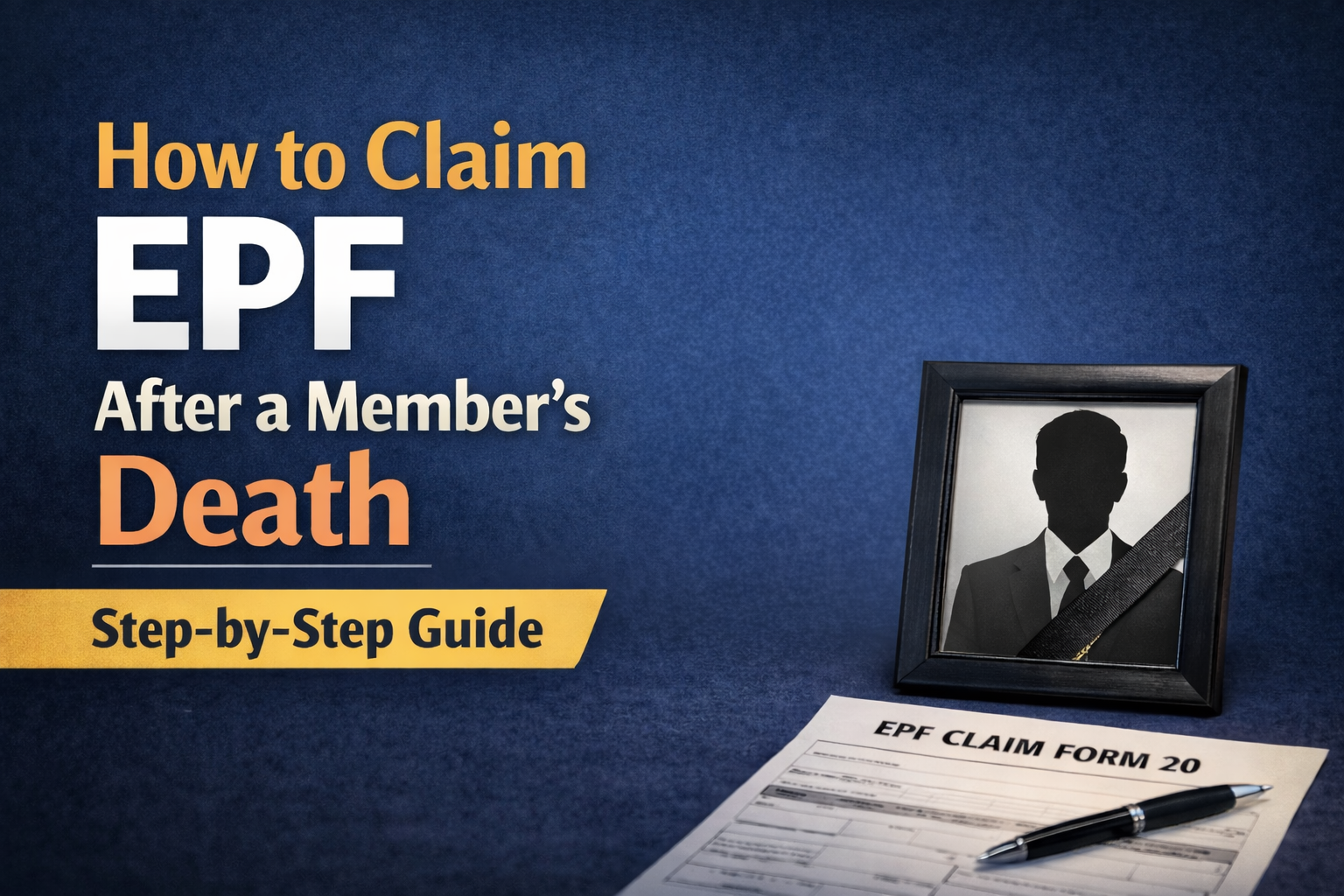
What is Form 20 in EPF?
Form 20 EPF is a claim form used by the nominee, family member, or legal heir to withdraw the Provident Fund balance of a deceased EPF member. It is submitted to the Employees' Provident Fund Organisation (EPFO) along with supporting documents to process the death claim and release the accumulated PF amount.
Why is Form 20 Important?
Form 20 is the essential document for legal heirs or nominees, used to claim the EPF amount after the death of a member. It is important for ensuring the safety of lifelong savings, financial support of the family after the death of a member, and preventing legal disputes thereafter.
The EPF Corpus Represents Lifelong Savings
The EPF corpus often represents years, sometimes decades of disciplined savings built through consistent monthly contributions by both the employee and employer. For many families, this accumulated amount becomes one of the most significant financial assets left behind after the member’s passing. In such circumstances, Form 20 EPF plays a crucial role in unlocking these savings and ensuring that the rightful beneficiary receives them without unnecessary hardship.
Immediate Financial Support for the Family
After the death of a member, the financial impact on the family can be immediate and overwhelming. The provident fund balance can provide urgent financial support, helping the family manage essential expenses during a period of emotional distress. It may be used to cover pending medical bills, daily household expenses, children’s education costs, rent, loan repayments, or other pressing financial obligations. In many cases, it acts as a stabilising cushion while the family adjusts to a new financial reality.
Legal Requirement for Withdrawal of EPF Balance
Submitting EPF Form 20 is not merely procedural; it is legally mandatory. Without filing the prescribed Form 20 PF claim, the EPF balance cannot be released by the Employees' Provident Fund Organisation. The organisation requires formal documentation to verify the claimant’s eligibility and ensure that the funds are transferred to the rightful nominee, family member, or legal heir.
Know more about PF Balance, Withdrawable Amount & Status in this guide.
Preventing Legal Disputes Through Proper Nomination
When a valid nomination exists, the submission of Form 20 EPFO death claim also prevents disputes among family members, as the registered nominee is clearly recognised under EPF rules. In this way, Form 20 not only facilitates financial settlement but also safeguards the family from potential legal complications.
Who Can File Form 20 EPF?
The eligibility for filing Form 20 depends on nomination status and family structure. It can be filed by a registered nominee, family member, legal heir or a guardian.
1. Registered Nominee (Preferred Scenario)
If the deceased member had filed Form 2 (Nomination), the registered nominee can directly file Form 20.
2. Family Member (If No Nomination Exists)
If no nomination was registered, the following family members may claim:
- Spouse
- Children
- Dependent parents
They may need to submit a legal heir certificate or succession certificate. (requirements vary depending on claim amount and EPFO office)
3. Legal Heir
If the deceased had no family as defined under EPF rules, a legal heir can file the claim with proper legal documentation.
4. Guardian (If Nominee is a Minor)
If the nominee is below 18 years of age, their legal guardian can file Form 20 on their behalf.
When is Form 20 Required?
Form 20 is an essential document that is required in various important circumstances. It is needed in case of the death of a member while in service, death after leaving employment, death after retirement with an unclaimed balance, or death with dormant or consolidated accounts.
Death While in Active Service
If a member dies while still employed, the nominee or eligible family member must begin the EPF death claim process step by step by submitting EPFO Form 20 along with supporting documents. This ensures that the accumulated provident fund is released to the rightful beneficiary without delay.
Death After Leaving Employment
If the member had resigned or changed jobs but had not withdrawn the PF balance, Form 20 EPF is still required. Even if several years have passed since the member’s last employment, the accumulated PF remains payable upon submission of the prescribed form.
Death After Retirement with Unwithdrawn Balance
In cases where the member retired but did not fully withdraw the provident fund corpus, the remaining amount can be claimed using Form 20 PF claim. Retirement does not automatically close the EPF account unless the full balance has been withdrawn.
Death with Dormant or Consolidated Accounts
Even if the EPF account is inactive or dormant, the consolidated balance linked through the UAN remains claimable. If the member changed jobs multiple times, all accumulated balances are combined, and the nominee or legal heir can claim the entire amount through a single Form 20 EPF submission.
Learn about UAN Activation & Multiple UANs: Common EPF Problems and How to Fix Them (2026 Guide)
Details Required in Form 20
These are the details needed for filing the form after the death of a member. To avoid delays, the form must be filled out carefully with accurate information:
- Name of deceased member (as per EPFO records)
- PF Account Number / UAN
- Date of death
- Last employer details
- Nominee or claimant name
- Relationship with the deceased
- Aadhaar number (if available)
- Bank account details (cancelled cheque attached)
- Contact information
- Signature/thumb impression of claimant
If filing offline, employer attestation may be required.
How to Fill Form 20 EPF (Step-by-Step Process)
Below is a simplified and structured process to help families complete the form correctly.
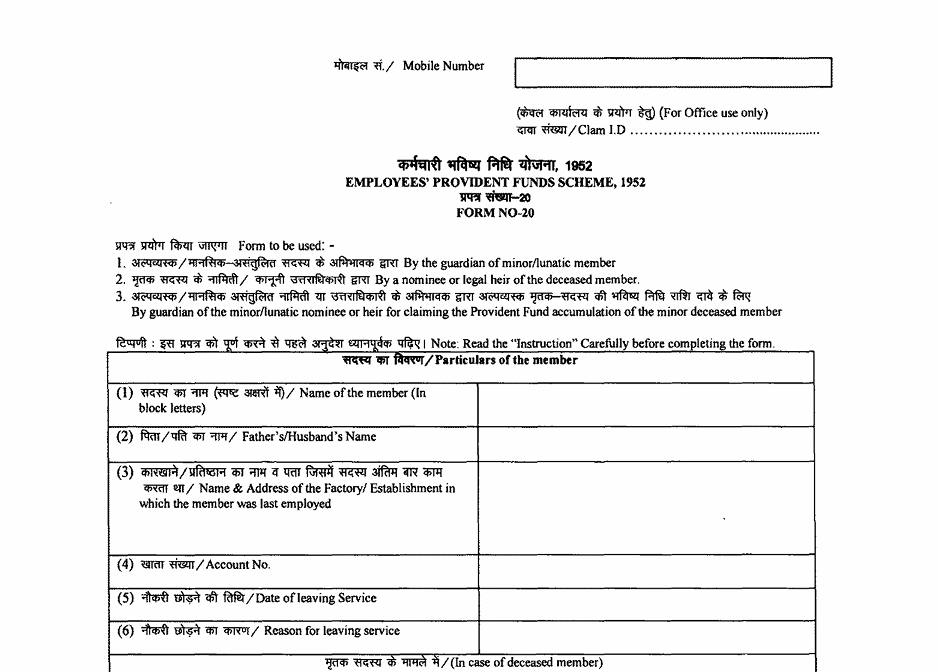
Step 1: Download Form 20
Visit the official EPFO website and download Form 20.
Step 2: Enter Member Details
Fill in:
- Name of deceased
- PF number
- UAN
- Date of death
Ensure spelling matches EPFO records exactly.
Step 3: Provide Claimant Information
Include:
- Full name
- Relationship with the deceased
- Address
- Bank details
Attach a cancelled cheque for verification.
Step 4: Attach Required Documents
Mandatory documents include:
- Death certificate
- Identity proof
- Bank proof
- Legal heir certificate (if required)
Step 5: Employer Certification
If the deceased was employed at the time of death, employer attestation is generally required.
Step 6: Submit to the Regional EPFO Office
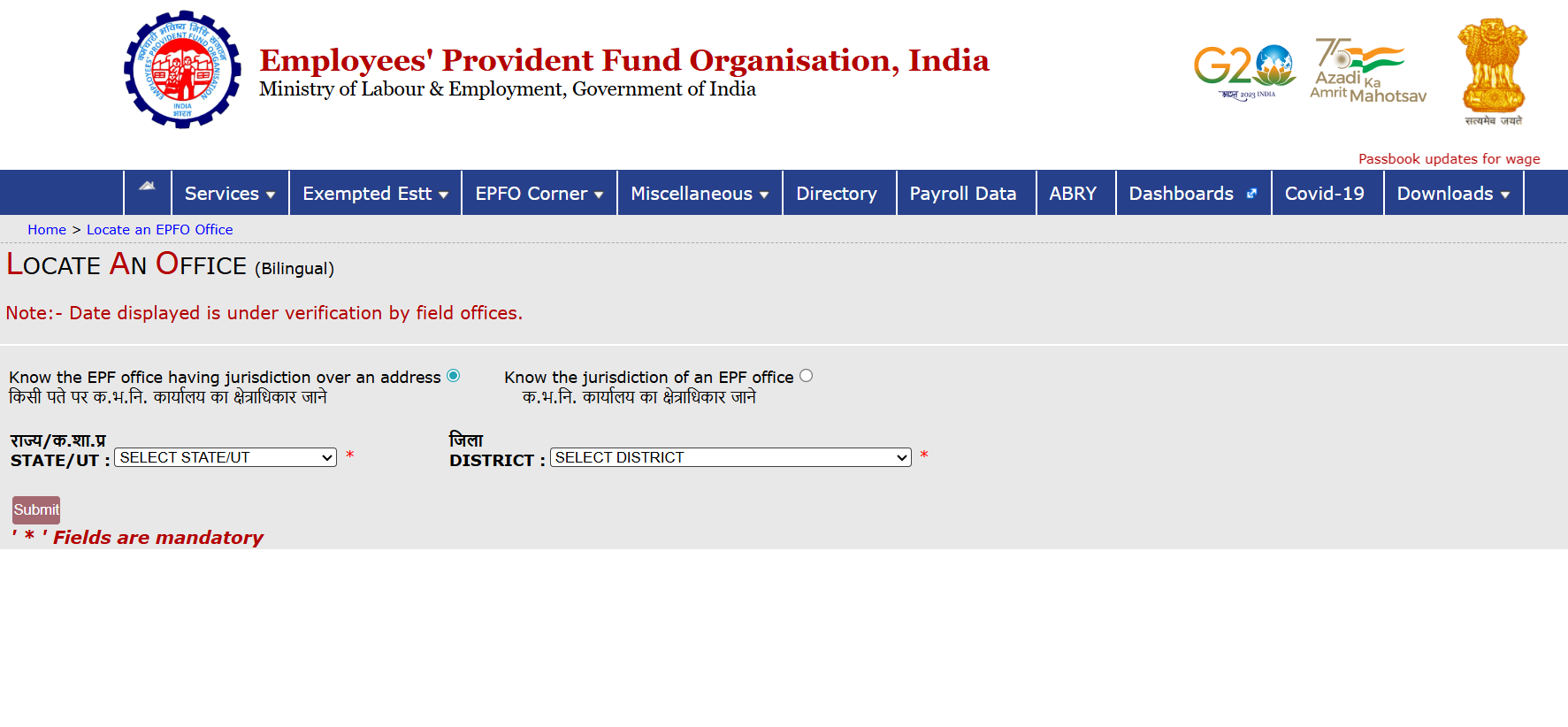
Submit the completed form to the concerned EPFO regional office.
Step 7: Track Claim Status
Claim status can be tracked online through the UAN member portal.
EPF Death Claim Process: Complete Workflow
Understanding the broader process helps reduce anxiety during submission. Here is the simplified workflow that you need to understand for getting the whole process together.
Workflow:
Death of Member → Verify Nomination → Fill Form 20 → Attach Documents → Submit to EPFO → Verification → Settlement to Bank Account
Processing Timeline
- Average processing time: 15–30 days
- Delays may occur if documents are incomplete
- SMS notification is sent upon settlement
Know about the EPF Death Claim Process in India (2026): Step-by-Step Guide for Legal Heirs
Documents Required for Form 20 EPF
Here is a clear checklist of documents that are needed while filling form 20. Have a look at these mandatory and additional documents to avoid any rejection:
Mandatory Documents
- Original or certified copy of the Death Certificate
- Completed Form 20
- Cancelled cheque with the claimant’s name
- Aadhaar copy of the claimant
Additional Documents (If Applicable)
- Legal heir certificate
- Succession certificate (in the absence of nomination)
- Guardian certificate (for minor nominee)
- Form 10D (for pension claim)
- Form 5IF (for EDLI insurance claim)
Form 20 vs Form 10D vs Form 5IF
Form 20 is used to claim the deceased member’s Provident Fund (PF) balance as a lump-sum amount.
Form 10D is for claiming monthly pension benefits under EPS, while Form 5IF is used to claim the EDLI insurance amount payable to the nominee or family.
| Form | Purpose | Who Files | Benefit Type |
| Form 20 | PF withdrawal | Nominee/Heir | Lump sum PF corpus |
| Form 10D | Pension claim | Spouse/Children | Monthly pension |
| Form 5IF | EDLI insurance | Nominee | Insurance benefit |
It is common for families to submit all three forms together.
Can Form 20 Be Submitted Online?
At present, Form 20 EPF is largely processed through offline submission. The claimant must download the form, fill it manually, attach the required documents, and submit it to the concerned regional EPFO office. In most practical death claim cases, offline submission is required.
Online Claim Tracking Through UAN Portal
Although the complete how to claim PF of a deceased employee is not fully online, claim status can be tracked digitally through the UAN member portal. This provides transparency and reduces the need for repeated office visits.
Employer Assistance and Digital Verification
In certain situations, employers assist with document forwarding or verification, particularly if the member was in active service at the time of death. If the account is Aadhaar-seeded and KYC details are updated, verification may proceed more smoothly and efficiently.
If your Aadhar is not linked to your UAN, read about How to Link Aadhar to Your UAN: Easy Way
Online vs Offline Comparison
| Criteria | Offline Submission | Online Tracking |
| Form Filling | Manual | Not fully online |
| Employer Attestation | Usually Required | Required |
| Claim Status | Not Available Offline | Available via UAN |
| Processing | Physical verification | Digital status updates |
Rules Based on Nomination Status
Check out these rules based on the nomination status of a member. Nomination plays an important role in the swift
Case 1: Valid Nomination Exists
When a proper nomination has been filed and recorded, the Form 20 EPF claim process is typically straightforward. After verification, EPFO releases the provident fund amount directly to the registered nominee.
Case 2: No Nomination Filed
If no nomination exists, the claim process becomes more documentation-heavy. The EPF death claim process step by step may require submission of legal heir certificates or succession certificates. Additional verification can extend the processing timeline.
Case 3: Minor Nominee
If the registered nominee is under 18 years of age, a legal guardian must file EPFO Form 20 on behalf of the minor. Proper guardianship documentation must accompany the claim to ensure lawful disbursement.
Case 4: Married Member Without Updated Nomination
In cases where a member is married but did not update their nomination, earlier nominations may become invalid under EPF rules. The spouse is often recognised as the primary beneficiary, subject to verification by the Employees' Provident Fund Organisation. This highlights the importance of keeping nomination records updated.
5 Common Mistakes to Avoid
i. Name Mismatch in Documents
A difference in spelling between EPF records, Aadhaar, and the death certificate can lead to delays in the Form 20 PF claim process. Ensuring consistency across all documents is critical.
ii. Incorrect Bank Account Details
Providing an incorrect IFSC code or a mismatched account holder name may result in payment failure. Since the amount is credited directly to the claimant’s account, bank details must be double-checked.
iii. Missing Employer Attestation
If the member was employed at the time of death, employer certification is generally required. Failure to obtain proper attestation can delay processing of EPF Form 20.
iv. Incomplete or Uncertified Documentation
Submitting photocopies without proper certification or missing mandatory documents, such as the death certificate, can result in objections from EPFO.
v. Ignoring Additional Benefit Forms
Families sometimes overlook related claims such as pension benefits. While submitting Form 20 EPFO death claim, it is important not to ignore associated forms like Form 10D for pension benefits, which may provide additional financial security.
Processing Time & Settlement Timeline
Standard Processing Timeline
The Employees' Provident Fund Organisation generally aims to process Form 20 EPF claims within 20 to 30 days. However, timelines may vary depending on documentation and verification requirements.
Factors That Affect Claim Processing
The completeness of submitted documents, clarity of nomination records, requirement of legal heir documentation, and workload of the regional EPFO office all influence processing time.
What Happens After Approval
Once the Form 20 EPFO death claim is approved, the provident fund amount is directly credited to the claimant’s bank account. An SMS notification is typically sent, and the claim status is updated online.
What to Do If There Is a Delay
If the claim remains pending beyond the expected timeline, the claimant can file a grievance through EPFO’s online grievance redressal mechanism. This ensures that unresolved cases receive formal attention and review.
When Should Form 20 Be Submitted?
It is advisable to submit Form 20:
- As soon as the death certificate is issued
- After gathering complete documentation
- Without unnecessary delay to avoid compliance complications
Even if the member left employment years ago, the PF remains claimable.
Practical Tips for Families
Reach Out to the Employer’s HR Department
During emotionally overwhelming times, navigating paperwork alone can feel exhausting. One of the first and most helpful steps is to contact the employer’s HR department. The HR team can guide you on how to initiate the Form 20 EPF process, confirm employment details, and assist with employer attestation if required. If the deceased member was actively employed at the time of death, HR coordination can significantly simplify the EPF death claim process step by step and reduce avoidable delays.
Verify Nomination Status Through the UAN Portal
Before submitting EPFO Form 20, it is important to verify whether a valid nomination exists. This can often be checked through the UAN member portal. Confirming nomination details early helps determine whether the claim will proceed smoothly through a registered nominee or require additional legal heir documentation. Understanding this in advance prepares the family for the documentation required for the Form 20 PF claim.
Keep Multiple Copies of All Documents
Documentation is central to a successful Form 20 EPFO death claim. Families should keep multiple photocopies of the death certificate, identity proof, bank documents, and any legal heir certificates. Having organised copies readily available prevents repeated visits to offices and reduces stress if additional verification is requested by the Employees' Provident Fund Organisation.
Maintain Calm and Organised Documentation
While the administrative process may seem procedural, it is ultimately structured to ensure that the rightful beneficiary receives the EPF savings securely. Keeping documents arranged systematically, cross-checking details carefully, and reviewing the completed EPF Form 20 before submission can help avoid unnecessary objections. Taking the process one step at a time makes it more manageable.
Understand That the System Is Designed to Support You
It is important to remember that EPF savings legally belong to the nominee or eligible family member. The purpose of Form 20 EPF is to facilitate the rightful transfer of these funds. Though the process involves verification and documentation, it exists to protect beneficiaries and ensure transparency. With proper paperwork and patience, families can successfully claim the provident fund amount that their loved one worked hard to build.
Frequently Asked Questions (FAQs)
1. Who is eligible to submit Form 20 EPF?
The primary person eligible to submit Form 20 is the registered nominee mentioned in the member’s Form 2 (Nomination) records. If a valid nomination exists, the claim process is usually straightforward and requires minimal additional legal documentation.
If no nomination was filed, eligible family members such as the spouse, children, or dependent parents can apply. In the absence of both nomination and eligible family members under EPF rules, a legal heir may submit the claim with proper legal documents such as a legal heir certificate or succession certificate.
2. Is Form 20 mandatory for the PF death claim?
Yes, Form 20 is legally mandatory to withdraw the EPF balance of a deceased member. The Employees’ Provident Fund Organisation (EPFO) cannot release the provident fund amount without receiving a properly filled and verified Form 20.
This form acts as the official request for settlement and ensures that the funds are transferred to the rightful nominee or eligible claimant after due verification.
3. Can Form 20 be filed completely online?
At present, Form 20 is largely processed through offline submission. The claimant must download the form, fill it manually, attach required documents, and submit it to the concerned EPFO regional office.
However, once submitted, the claim status can be tracked online through the UAN Member Portal. In some cases where KYC and Aadhaar details are fully updated, verification may be smoother, but physical documentation is still generally required for death claims.
4. How long does an EPF death claim settlement take?
The average processing time for an EPF death claim is 15 to 30 days from the date of complete submission. However, timelines may vary depending on:
- Completeness of documentation
- Nomination clarity
- Requirement of additional legal certificates
- Workload at the regional EPFO office
If documents are incomplete or discrepancies are found, processing may take longer.
5. What happens if no nomination is filed?
If no nomination exists, the claim process becomes more documentation-intensive. Eligible family members must submit a legal heir certificate or, in some cases, a succession certificate, depending on the claim amount and EPFO requirements.
The EPFO will verify the rightful beneficiaries before releasing the amount. This may extend the processing timeline compared to cases where a valid nomination exists.
6. Can multiple heirs claim simultaneously?
Yes, if no registered nominee exists, all eligible legal heirs can submit a joint claim. In such cases, the EPF amount is distributed among the eligible heirs as per EPF rules.
Joint declarations and proper documentation are required to avoid disputes and ensure smooth settlement.
7. Is employer attestation compulsory?
If the member was employed at the time of death, employer attestation is generally required to confirm service details and validate the claim.
However, if the member had already left employment and the account is Aadhaar-seeded with updated KYC details, employer attestation requirements may vary depending on the EPFO office. It is always advisable to coordinate with the employer’s HR department to prevent delays.
Final Thoughts
Form 20 EPF is more than just paperwork it is a bridge between years of hard-earned savings and the financial stability of a grieving family.
While the process may seem procedural, it is structured to ensure rightful beneficiaries receive what is legally theirs. Taking the time to submit accurate information and complete documentation can significantly reduce delays.
If you are supporting a family through this process, approach it patiently and systematically. And if you are currently employed, consider ensuring your nomination details are updated - it is one of the simplest yet most meaningful financial protections you can provide your loved ones.
How Kustodian Can Help You
Navigating the Form 20 EPF process during a time of loss can feel overwhelming. At Kustodian, we aim to simplify the EPF death claim process step by step by guiding families through documentation, verification, and submission requirements with clarity and compassion.
Our team helps you understand eligibility, verify nomination details, prepare the correct documents for the Form 20 PF claim, and avoid common errors that may delay settlement.
We also assist in coordinating with employers where required and provide structured support so that your EPFO Form 20 submission is complete and compliant.
Most importantly, we ensure that families can focus on what truly matters while we help streamline the administrative process. With the right guidance, claiming the EPF balance becomes less stressful and more manageable.
Disclaimer: This article is for informational purposes only and does not constitute legal or financial advice. Rules may vary based on individual records and EPFO processing.