Learn how legal heirs can claim EPF after the death of a member. Step-by-step process, required documents, Aadhaar rules, and latest EPFO updates for 2026
- Introduction
- Understanding EPF Death Claim
- EPF Death Claim Eligibility Rules (2026)
- Documents Required for EPF Death Claim
- EPF Death Claim Process: Step-by-Step Guide
- EPF Death Claim and Aadhaar Linking
- Common Reasons for EPF Death Claim Delays or Rejections
- Legal Heir vs Nominee
- EDLI Insurance: Step-by-Step Guide for Legal Heirs and Nominees
- Latest Updates on EPF Death Claims (2026)
- What to Do If There Is No Nominee
- Frequently Asked Questions (FAQs)
- Conclusion
Introduction
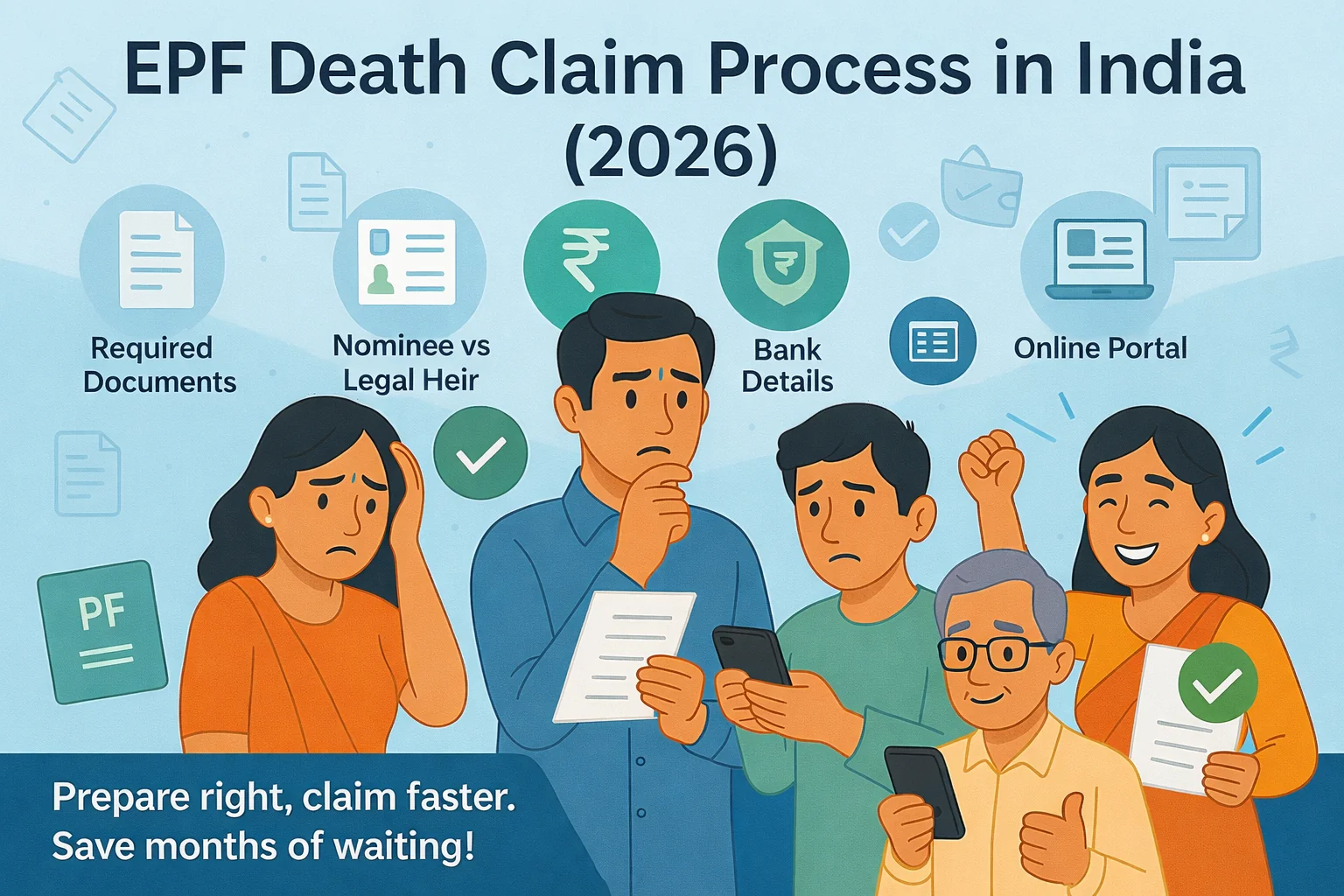
Losing a loved one is never easy. Amidst grief, managing financial matters can feel overwhelming, especially when it comes to claiming the Employees’ Provident Fund (EPF) of the deceased. EPF is more than just retirement savings; it’s a financial lifeline that can provide essential support to the family during such difficult times.
You’re not alone; many families face delays and rejections simply because they are unaware of the correct EPF death claim rules, Aadhaar requirements, or documentation process.
Understanding EPF Death Claim
When an EPF member passes away, their Employees’ Provident Fund (EPF) balance, built over years of contributions, does not lapse. Instead, it becomes a claimable amount for their family. This process is known as an EPF death claim, where the rightful claimant can receive the employee’s contribution, employer’s share, and interest earned.
Who Can Claim EPF After a Member’s Death?
- Nominee: If the EPF account has a registered nominee, that person has the first and primary right to claim the funds.
- Legal Heirs: If no nominee exists, or if the nominee has also passed away, the EPF claim legal heirs can apply. Legal heirs generally include the spouse, children, dependent parents, or siblings, as per EPFO’s defined priority order.
- Other Family Members: In some cases, if none of the above are listed, other family members may claim by producing a valid legal heir certificate or succession certificate.
Why This Claim Matters
An EPF death claim is not just about paperwork; it can provide immediate financial relief to the family during a very difficult time. The funds can:
- Help cover urgent expenses like medical bills, education, or household needs
- Support loan repayments or financial liabilities
- Provide a financial cushion while the family regains stability
Beyond finances, completing the PF death claim process ensures the deceased member’s hard-earned savings reach the right beneficiaries promptly, offering both peace of mind and closure.
EPF Death Claim Eligibility Rules (2026)
Knowing who can claim an EPF death benefit is essential to avoid delays and disputes. EPFO rules define clear eligibility so that funds reach the rightful beneficiary, whether a nominee, legal heir, or dependent family member.
(EPF death claim eligibility is governed by the Employees' Provident Funds and Miscellaneous Provisions Act, 1952, and related EPFO scheme rules.)
Nominee vs. Legal Heir
- Nominee: The nominee registered in the EPF account is the first person entitled to claim benefits after the member’s death. If documents are in order, the process is usually quick and straightforward.
- Legal Heir: If no nominee is registered, or if the nominee has passed away, the claim can be made by legal heirs. Legal heirs are decided as per Indian succession laws and must submit a legal heir certificate for verification.
What if the Nominee is Not Updated or is a Minor?
- No Nominee Registered: The claim goes to the legal heirs, based on succession law.
- Minor Nominee: A parent or guardian can file the claim on behalf of the minor. EPFO accepts claims in the minor’s name with supporting documents.
Priority Order of Family Members (if no nominee exists)
EPFO follows a defined order of preference:
- Spouse
- Children
- Dependent parents
- Siblings
This avoids disputes among family members and ensures fair distribution.
NRIs Claiming EPF Death Benefits
Non-Resident Indians (NRIs) can also claim EPF death benefits. The process may involve extra steps:
- Ensure Aadhaar and KYC details are updated before filing the claim.
- Submit a nominee or legal heir certificate, attested by Indian authorities.
- File the claim online carefully, or consider using a trusted representative in India for faster processing.
By keeping nominee details updated and understanding these rules, families can ensure the EPF death claim is processed smoothly, without unnecessary legal or administrative hurdles.
Documents Required for EPF Death Claim
Before you start the EPF death claim process, gather all necessary documents in advance. A complete file prevents delays and makes the process smoother for your family.
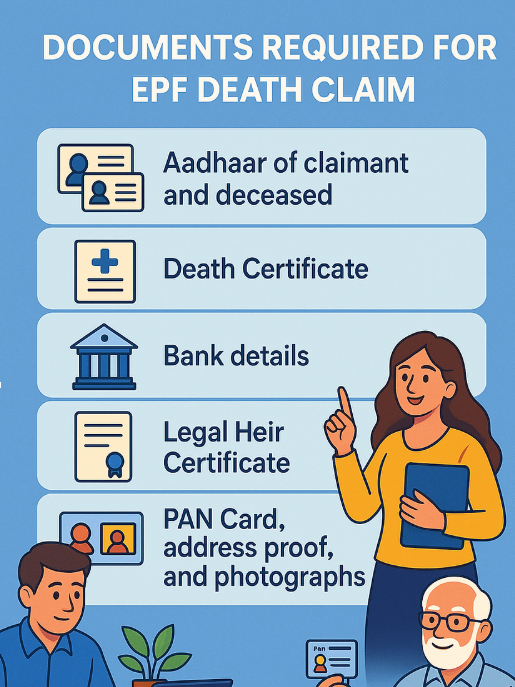
Essential Documents Checklist
- Aadhaar of the claimant and the deceased - Used for e-KYC verification. Ensure the details exactly match EPFO records.
- Death Certificate - Issued by the municipal authority or hospital. This is the primary document to initiate the claim.
- Bank details of the claimant - Include account number, IFSC code, and a cancelled cheque or passbook copy for transferring funds.
- Legal Heir Certificate (if no nominee exists) - Required when the EPF account has no registered nominee. It proves the claimant’s legal right to receive benefits.
- PAN Card, address proof, and photographs - These help EPFO verify the claimant’s identity and prevent fraud.
- Employer’s certification (if applicable) - In some cases, the employer must confirm details such as service period, contributions, or employment status of the deceased member.
Pro Tip: If filing online, keep scanned copies of all documents ready. Make sure they are:
- Clear and legible
- Correctly named (e.g., “Death Certificate.pdf”)
- Matching details across Aadhaar, bank, and EPFO records
EPF Death Claim Process: Step-by-Step Guide
Claiming EPF after the death of a member can feel overwhelming, but knowing the exact process helps reduce stress. The Employees’ Provident Fund Organisation (EPFO) offers two modes of claim submission, online (preferred for speed) and offline (if digital submission isn’t possible).
Online Process (Preferred)
- Login to the EPFO Portal - Visit the official EPFO website and login through the EPFO member portal (or initiate through the offline process if not accessible)
- Go to Services → Death Claim - Select the option for “Death Claim” under services.
- Upload Required Documents - Scan and upload all mandatory documents, such as Aadhaar, death certificate, bank details, and legal heir certificate (if applicable).
- Verification & Attestation - EPFO verifies Aadhaar details. In some cases, the deceased member’s employer may also need to attest the claim.
- Track Claim Status - Once submitted, you can monitor progress on the EPFO portal until settlement.
Pro Tip: Ensure all details (name, Aadhaar, bank account) match EPFO records. Even small mismatches can delay approval.
Note: Aadhaar is “mandatory for online claims” and “strongly required for smooth processing.
Offline Process (If Online Is Not Possible)
Even though online submission is faster, claims can still be filed offline in case of technical issues or missing e-KYC details.
- Fill the Required Forms
- Attach Supporting Documents - Include death certificate, Aadhaar, PAN, legal heir certificate (if no nominee exists), bank details, and photographs.
- Submit to Employer or EPFO Office - Submit the forms and documents through the deceased member’s employer or directly at the EPFO regional office.
All three forms can now also be submitted online if the claimant’s Aadhaar is linked and e-KYC is complete. Offline submission is only needed if digital filing is not possible.
For a deeper understanding of EPF forms, their specific usage, and the latest digital filing updates, check out our guide: EPFO Forms 2026 Guide: Meaning, Uses & Latest Digital Filing Rules.
Processing Timeline
- Online claims – Typically settled within 15-30 days, if documents are complete.
- Offline claims – May take 30-45 days, depending on verification needs.
- Delays – Commonly caused by mismatched names, incorrect bank details, or missing certificates.
EPF claims are just one part of the financial responsibilities that follow after a loss. If you want broader guidance on handling expenses, liabilities, and planning for stability, you can explore our step-by-step guide on Managing finances after the death of a family member
EPF Death Claim and Aadhaar Linking
In 2026, Aadhaar became mandatory for all EPF claims, including death claims. Linking Aadhaar ensures faster e-KYC verification, accurate processing, and direct transfer of funds into the claimant’s bank account. For nominees or legal heirs, correct Aadhaar details are often the difference between a smooth process and frustrating delays.
Why Aadhaar Is Mandatory for EPF Death Claims
- Identity verification – EPFO uses Aadhaar for e-KYC to confirm the claimant’s identity.
- Fraud prevention – Helps ensure funds reach the rightful beneficiary.
- Online claim requirement – No EPF death claim can be processed online without Aadhaar authentication.
Common Aadhaar Mismatch Issues
Even minor errors can result in claim rejection. The most frequent Aadhaar-related problems in EPF death docs are:
- Name mismatch – e.g., “R. Kumar” in EPF records vs “Ravi Kumar” in Aadhaar
- Date of Birth mismatch – Wrong DOB in EPFO records vs Aadhaar database
- Gender discrepancies – Incorrect or missing gender details in either record
These mismatches often lead to unnecessary delays, sometimes stretching the process by weeks.
How to Correct Aadhaar Details Before Filing EPF Death Claim
- Verify details on UIDAI portal – Cross-check name, DOB, and other details.
- Update errors if required – Submit corrections online or visit an Aadhaar enrollment/update center.
- Resubmit with updated Aadhaar – Always attach the corrected Aadhaar copy when filing the EPF death claim.
Pro Tip: Double-check Aadhaar details for both the deceased member and the claimant before submission. Even a single mismatch can hold up the claim unnecessarily.
Common Reasons for EPF Death Claim Delays or Rejections
Even with the right intentions, many families face EPF death claim delays or outright rejections. The good news? Most issues are avoidable if you know them in advance. Below are the most common reasons why claims get stuck and how you can prevent them.
1. Missing or Incomplete Documents
- Death certificate not attached or an unclear copy submitted
- Aadhaar/PAN/Bank details missing
- Legal heir certificate not provided (when no nominee exists)
- Blurry or unreadable scanned copies
Solution: Always prepare a full checklist of EPF death docs before applying and keep both physical and digital copies ready.
2. Aadhaar or PAN Mismatch
- Spelling mistakes in name (e.g., “R. Sharma” vs “Rajesh Sharma”)
- Wrong date of birth in Aadhaar vs EPFO records
- Initials vs full name mismatch
Solution: Verify Aadhaar and PAN details on both the EPFO portal and UIDAI database before submitting your claim.
3. No Nominee Updated in EPFO Records
- If the deceased member didn’t nominate anyone, EPFO will not release funds directly.
- In such cases, legal heirs must provide a succession certificate or legal heir certificate, which takes extra time.
Solution: Always update nominee details while the member is alive. If no nominee exists, be prepared with heirship documents.
4. Bank Account Details Mismatch
- Incorrect account number or IFSC code entered
- Bank account not in claimant’s name
- Dormant/inactive bank account provided
Solution: Double-check bank details carefully. Use an active account in the claimant’s name with Aadhaar and PAN linked.
| Reason | Examples |
| Missing or Incomplete Documents | · Death certificate not attached or unclear copy· Aadhaar/PAN/Bank details missing· Legal heir certificate not provided (when no nominee exists)· Blurry or unreadable scanned copies |
| Aadhaar or PAN Mismatch | · Spelling mistakes in name (e.g., “R. Sharma” vs “Rajesh Sharma”)· Wrong date of birth in Aadhaar vs EPFO records· Initials vs full name mismatch |
| No Nominee Updated in EPFO Records | · No nominee details available in EPFO records· EPFO cannot release funds directly |
| Bank Account Details Mismatch | · Incorrect account number or IFSC code· Bank account not in claimant’s name· Dormant or inactive bank account provided |
Tips to Avoid EPF Death Claim Rejections
- Double-check all documents for completeness and accuracy
- Match Aadhaar, PAN, and bank details exactly with EPFO records
- Keep digital copies ready for online submissions
- Update nominee information proactively to save heirs from legal hurdles
Many families face unexpected hurdles when EPS (Employees’ Pension Scheme) issues crop up during an EPF death claim. To understand why EPS-related rejections happen and how to resolve them effectively, explore our detailed guide: EPF Claim Rejected Because of EPS? Top Reasons and Proven Fixes.
By addressing these common pitfalls early, you can avoid rejection and reduce delays, ensuring that the EPF death claim is settled smoothly and quickly.
Legal Heir vs Nominee
A common doubt families face during the EPF death claim process is:“Who can claim the EPF - nominee or legal heir?”
Understanding this difference is crucial to avoid disputes and delays.
Nominee: The First Rightful Claimant
A nominee is the person officially registered by the EPF member to receive funds after their death. Since the nomination reflects the member’s own choice, EPFO gives first priority to the nominee’s claim.
When the nominee alone is enough:
- The nominee is alive and correctly registered in EPFO records
- Aadhaar, bank, and KYC details match without errors
- There are no disputes raised by other family members
In these cases, the settlement is usually quick and straightforward.
Legal Heir: When Extra Verification is Required
If there is no nominee updated or the nominee has passed away, the claim can be made by the legal heirs of the deceased. Legal heirs are determined under Indian succession laws.
Documents required for legal heirs:
- Legal heir certificate (issued by Tehsildar/municipal authority)
- Succession certificate (may be required when multiple heirs exist or disputes arise)
Important Tip: Even if a nominee is present, legal heirs may sometimes need to step in, especially if the nominee’s documents are incomplete, Aadhaar mismatches occur, or disputes arise. Always confirm EPFO’s specific document requirements before filing.
| Aspect | Nominee | Legal Heir |
| Who They Are | Person registered by the EPF member to receive funds after their death | Family members entitled under Indian succession laws (spouse, children, parents, etc.) |
| Priority in Claim | First and primary claimant; EPFO settles directly if records are clear | Claim only arises when no nominee is updated or nominee has passed away |
| When Applicable | · Nominee alive and correctly registered in EPFO records· Aadhaar, bank, and KYC details match· No disputes raised by family | · No nominee updated in EPFO records· Nominee deceased· Disputes among family members regarding entitlement |
| Documents Required | – Aadhaar, bank, and KYC documents of nominee | · Legal heir certificate (Tehsildar/municipal authority)· Succession certificate (if multiple heirs/disputes) |
| Settlement Speed | Usually quick and straightforward | Longer process, requires additional verification and court-issued certificates |
EDLI Insurance: Step-by-Step Guide for Legal Heirs and Nominees
When a salaried employee who is a member of the Employees’ Provident Fund (EPF) passes away during service, the family is not only entitled to the EPF balance and EPS pension benefits, but also to an insurance payout under the Employees’ Deposit Linked Insurance (EDLI) Scheme. Many families are unaware of this, and end up missing a crucial financial support.
What is EDLI in EPF?
The Employees’ Deposit Linked Insurance (EDLI) is a life insurance scheme linked to the EPF. It provides a lump-sum insurance cover to the nominee or legal heir of the deceased employee, without requiring the employee to pay any separate premium. Contributions towards EDLI are made by the employer.
EDLI Insurance Amount (2026)
As per the latest EPFO notification:
- The maximum EDLI payout is ₹7 lakh.
- The minimum payout is ₹2.5 lakh (subject to eligibility).
- The actual amount is calculated based on the average balance and last drawn salary, but capped at ₹7 lakh.
Eligibility for EDLI Claim
- Available if the EPF member was in active service at the time of death.
- Nominee registered in the EPFO records has the first right.
- If no nominee exists, legal heirs can claim EDLI benefits by submitting proof (succession certificate/legal heir certificate).
Documents Required for EDLI Claim
To claim EDLI benefits, families usually need to submit:
- Form 5IF (EDLI claim form)
- Death certificate of the employee
- Aadhaar and KYC details of the claimant
- Bank account details of the nominee/legal heir
- Succession/Legal Heir Certificate (if no nominee exists)
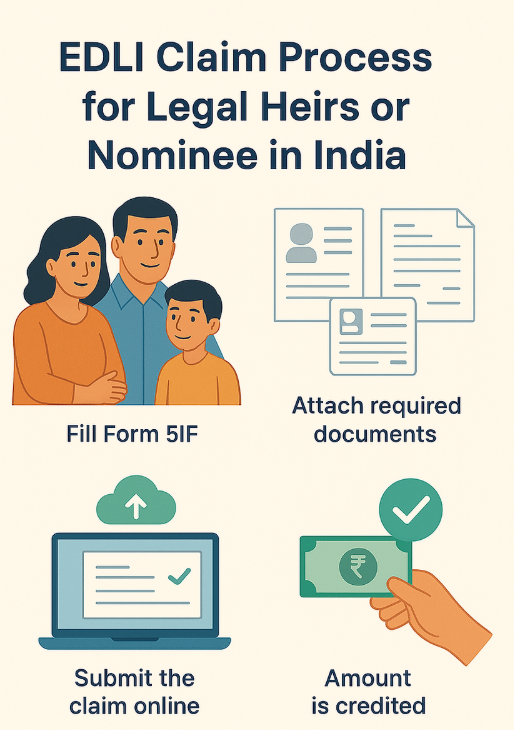
How to File an EDLI Claim (Step-by-Step)
- Download and fill Form 5IF from the EPFO website.
- Attach required documents (death certificate, Aadhaar, bank details, etc.).
- Submit the claim online through the EPFO portal (if Aadhaar-seeded) or offline at the regional EPFO office.
- Once verified, the insurance amount is credited directly to the nominee/legal heir’s bank account.
| Category | Details |
| Eligibility | · EPF member must be in active service at the time of death· Nominee registered in EPFO records has the first right· If no nominee, legal heirs can claim with a succession/legal heir certificate |
| Documents Required | · Form 5IF (EDLI claim form)· Death certificate· Aadhaar & KYC of claimant· Bank account details of nominee/legal heir· Succession/Legal heir certificate (if no nominee exists) |
| Claim Process (Step-by-Step) | 1. Download & fill Form 5IF from EPFO website2. Attach required documents3. Submit online via the EPFO portal (if Aadhaar-seeded) OR offline at the regional EPFO office4. Amount credited directly to the nominee/legal heir’s bank account after verification |
Pro Tip: Since EDLI is settled alongside EPF and EPS claims, it’s best to file them together to save time and avoid duplicate paperwork.
Latest Updates on EPF Death Claims (2026)
EPFO has been modernizing the EPF death claim process to make it faster and more transparent. Staying updated with the latest rules can help families avoid delays and ensure smooth claim settlement. Here’s what’s new in 2026:
1. Digital-Only Verification Rollout
EPFO is moving towards digital-only verification for most EPF death claims. This means that claimants can complete the process online without visiting the regional EPFO office, saving time and reducing paperwork.
2. Aadhaar-Based e-KYC for Nominees
Aadhaar e-KYC has become mandatory for nominees. This allows instant verification of identity, ensuring that the EPF amount is transferred to the rightful claimant. Legal heirs and nominees are encouraged to update their Aadhaar details before initiating the claim to prevent mismatches.
3. Faster Settlement Timelines
With these digital initiatives, EPFO has announced faster settlement timelines. Online claims with complete and accurate documents can now be processed within 15–30 days, compared to the longer durations of offline claims.
Pro Tip: Even with digital verification, it’s essential to double-check all documents, Aadhaar details, and bank information to avoid unnecessary delays.
4. No More Guardianship Certificates for Minor Beneficiaries
In the circular dated August 13, 2025, EPFO directed that offices shall not insist on a separate guardianship certificate for death claim settlements when the amount is credited directly to the bank accounts of minor children.
This removes a long-standing procedural hurdle, especially beneficial when a parent passes away and the child is a minor.
Even with the latest reforms, members and legal heirs still run into practical challenges while filing EPF claims. If you’re looking for step-by-step fixes to the most common problems, check out our resource: Real Solutions for Common PF Problems
What to Do If There Is No Nominee
Sometimes, EPF accounts may not have a registered nominee, or the nominee may have also passed away. In such cases, the legal heirs of the deceased are entitled to claim the EPF, but the process requires additional verification. Understanding the steps can make this process much smoother.
Step-by-Step for Legal Heirs Without a Nominee
- Obtain a Legal Heir Certificate – This certificate, issued by the local Tehsildar or municipal authority, confirms who the legal heirs are.
- Prepare Required Documents – Along with the legal heir certificate, gather the death certificate, Aadhaar, PAN, bank details, and other necessary documents.
- Submit the Claim to EPFO – Submit the documents online through the EPFO portal or offline via the regional EPFO office.
- Employer Verification (if applicable) – Some claims may require certification from the deceased member’s employer regarding service and contributions.
- Follow-Up – Track the claim status regularly through EPFO’s online portal to ensure timely processing.
Requirement of Succession / Legal Heir Certificate
- The legal heir certificate proves the claimant’s right to receive the EPF when no nominee exists.
- In complex cases, such as multiple heirs or disputes, a succession certificate may be required from a civil court. This provides stronger legal validation for the claim.
Approximate Timelines & Court Procedure
- With Legal Heir Certificate: EPF claims usually take 30-45 days, depending on document verification.
- With Succession Certificate (if needed): The process may take longer, often 2-3 months, as it involves court verification and additional documentation.
Apart from EPF, many families are also entitled to other unclaimed assets left behind by the deceased, such as bank deposits, insurance, or mutual funds. To learn how to claim these, check out our detailed guide on claiming unclaimed assets of a deceased in India
Frequently Asked Questions (FAQs)
1. How long does EPF death claim settlement take?
Online claims with complete and correct documents are typically processed within 15–30 days. Offline claims or claims requiring legal heir verification may take 30–45 days or longer.
2. Can EPF death claim be done without Aadhaar?
Aadhaar is mandatory for online claims. For offline claims, submission may be possible without Aadhaar, but EPFO strongly recommends updating Aadhaar to ensure faster verification and settlement.
3. What if the nominee has also passed away?
If there is no valid nominee, the legal heirs can claim the EPF using a legal heir certificate or succession certificate. The claim will follow EPFO’s priority order: spouse → children → dependent parents → siblings.
4. Is a legal heir certificate mandatory for EPF death claim?
Yes, a legal heir certificate is required if no nominee exists or if the nominee is unable to claim. It establishes the claimant’s legal right to the deceased member’s EPF balance.
5. Can NRIs apply for EPF death claim online?
Yes, NRIs can submit death claims online, but they must ensure Aadhaar and KYC details are updated and submit a nominee or legal heir certificate attested by Indian authorities.
6. What documents are required for EPF death claim?
Key documents include: death certificate, Aadhaar of claimant and deceased, bank details, legal heir certificate (if no nominee), PAN, address proof, photographs, and employer certification if applicable.
7. Can minor children claim EPF after a parent’s death?
Yes, a guardian or parent can claim EPF on behalf of minor children. Proper documentation, including the death certificate and Aadhaar details of the minor, is required.
8. What are common reasons for EPF death claim delays or rejection?
Common issues include missing documents, Aadhaar/PAN mismatch, no nominee, and incorrect bank details. Ensuring accuracy and completeness reduces delays significantly.
9. Can EPF death claims be disputed by family members?
Disputes may arise if multiple heirs exist or if nominee details are unclear. In such cases, EPFO may require succession certificates or legal intervention to settle the claim.
10. How to check EPF death claim status online?
After submission, claimants can track the status through the EPFO member portal by logging in and navigating to the ‘Track Claim Status’ section. Notifications are also sent via email/SMS if registered.
Conclusion
Claiming an EPF after a loved one’s death is not just a financial step, it’s a right for the family or legal heirs. While the process can seem overwhelming, having the right documents, accurate Aadhaar and bank details, and understanding the eligibility rules ensures that the claim is processed smoothly and reaches the rightful beneficiaries without unnecessary delays.
Navigating nominee vs legal heir rules, Aadhaar verification, and EPFO procedures may feel complex, but with careful preparation, it can be straightforward.
If you’re dealing with challenges around EPF death claims, Aadhaar mismatches, or legal heir documentation, Kustodian.life can help make the process simpler and stress-free.
How Kustodian Can Help
Our experts guide families step-by-step to ensure claims are filed accurately and settled without unnecessary delays, so you can focus on what truly matters: supporting your loved ones during a difficult time. To get personalized guidance, you can also schedule a call with our experts and take the next step with confidence.