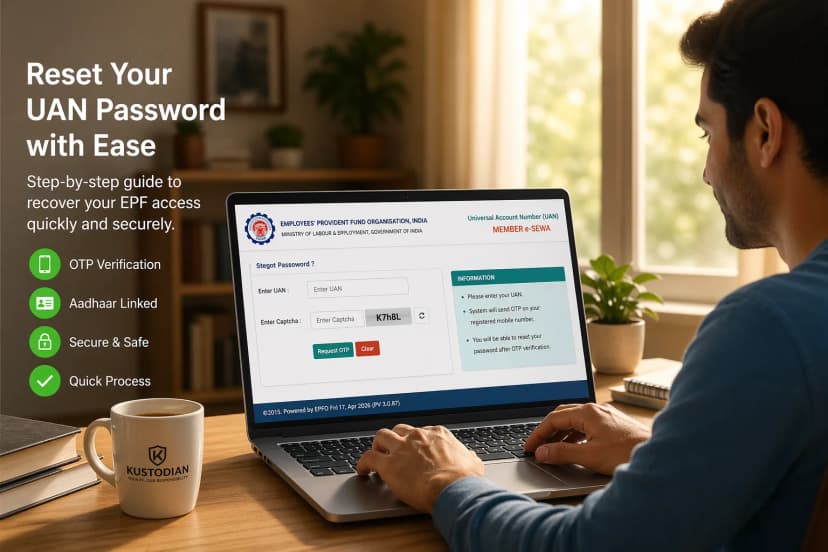
What “KYC Not Verified” Means in EPF
EPF KYC is not verified when Aadhaar, bank, or PAN details are not approved or do not match EPFO records. The most common reasons include bank approval pending, Aadhaar not linked, or delays in employer verification.
1. Why Your EPF Claim Was Rejected Due to KYC (Quick Answer)
EPF claims are commonly rejected due to KYC-related issues when Aadhaar, bank, or PAN details are not verified or do not align with EPFO records. Even small inconsistencies or pending approvals can prevent the system from completing the transaction.
The most common causes include:
- Aadhaar not verified or not linked with UAN
- Bank account not approved or incorrectly entered
- IFSC or account number errors
- Name mismatch between bank and EPF records
- Employer approval pending
In most cases, these are validation issues rather than eligibility problems, which means they can be corrected and the claim can be resubmitted.
2. How EPF KYC Verification Works
One of the biggest reasons users get stuck is that the EPF verification process is not clearly visible. What looks like a simple “KYC pending” message actually involves multiple systems working together. Here’s how the process works behind the scenes:
User updates KYC
↓
Bank verifies account details
↓
Employer approves (if required)
↓
EPFO updates status
Each step depends on the previous one. If any stage fails or is delayed, the entire process stops. For example:
- If your bank does not confirm your account details, verification remains incomplete
- If your employer does not approve the request, it stays “pending” indefinitely
- If Aadhaar is not properly linked, the system cannot validate your identity
This is why two users with the same issue may experience different delays—because the bottleneck can exist at different points in the chain. Understanding where your request is stuck is the first step to fixing it correctly.
3. Common EPF KYC Error Messages (And What They Mean)
When your EPF claim or KYC update fails, the system usually shows a short message. These messages can be vague, but they directly point to the underlying issue. Below are the most common EPF KYC-related error messages and what they actually mean:
| EPF Error Message | Shown As | Meaning | What To Do |
|---|---|---|---|
| KYC not verified as per EPFO records | KYC incomplete / not approved | Aadhaar/bank not approved | Complete verification |
| Bank seeded against UAN but not approved by the employer | Bank not approved | Employer approval pending | Follow up |
| Aadhaar not seeded with UAN | Aadhaar not linked | Aadhaar not connected | Link Aadhaar |
| Invalid IFSC or account details | Bank error | Incorrect bank details | Update details |
These messages are often the fastest way to identify the issue. If you can match your status message to one of the above, you already know where the problem lies.
4. EPF KYC Issue — Quick Diagnosis
If you’re unsure what exactly is wrong, you can use a simple rule to identify the issue category based on the message you see.
- If the message mentions KYC not verified, it usually points to Aadhaar or bank verification
- If it mentions bank not approved, the issue is with the employer or the bank-side approval
- If it shows IFSC or account error, the problem is incorrect bank details
This quick mapping helps you avoid trial-and-error fixes and go directly to the correct solution.
5. Identify Your KYC Issue (Start Here)
Before trying to fix anything, it’s important to identify the exact type of issue. Many users attempt multiple changes without knowing the root cause, which leads to repeated rejections.
Use the scenarios below to find the right path:
- If your Aadhaar is not verified → proceed to fix Aadhaar KYC
- If your bank account is not approved → fix the bank verification
- If your name does not match your bank records → correct the name mismatch in EPF
- If your status shows “pending with the employer,” → check employer approval steps
Identifying the correct issue first saves time and avoids repeated claim failures.
6. How to Fix EPF KYC Issues (Step-by-Step)
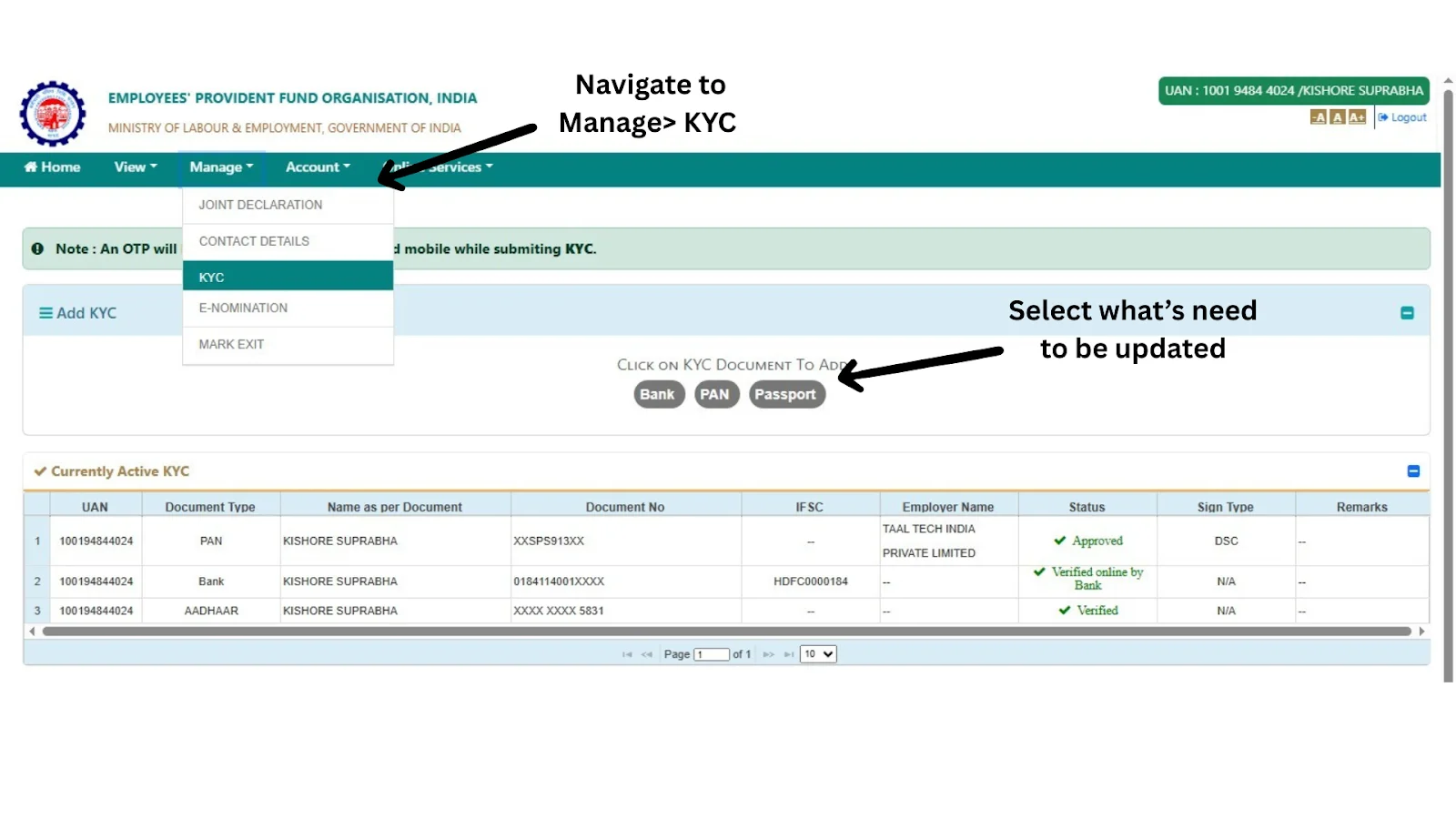
Once you’ve identified the issue, the next step is to resolve it correctly. Each type of KYC status error has a different fix, and following the right process is important to avoid delays. Most users resolve KYC issues by fixing a single step—repeated failures usually indicate an approval-level problem rather than incorrect data.
- Fix Aadhaar KYC: If your Aadhaar is not verified or not linked:
- Log in to the Unified Portal (UAN)
- Go to the KYC section
- Enter or update your Aadhaar details
- Complete OTP-based verification
Estimated time: Instant to 24 hours
Avoid sharing full sensitive ID details on public grievance portals. Only provide required or masked information where applicable.
- Fix Bank Verification: If your bank details are not approved:
- Check your account number and IFSC carefully
- Update incorrect details if needed
- Submit for approval through the portal
Estimated time: 3–7 working days
In some cases, the issue may not be on the EPFO side. If your bank account is inactive, dormant, or has restricted KYC, the bank may reject the verification request. In such cases, you may need to reactivate the account or update details before retrying.
- Fix PAN (If Required): For certain withdrawals, especially higher amounts, PAN verification may be required:
- Update PAN details in the portal
- Ensure the PAN is verified successfully
Estimated time: 1–3 working days
Once the relevant issue is fixed, you can reapply your claim. Most users see successful processing after resolving the underlying verification problem.
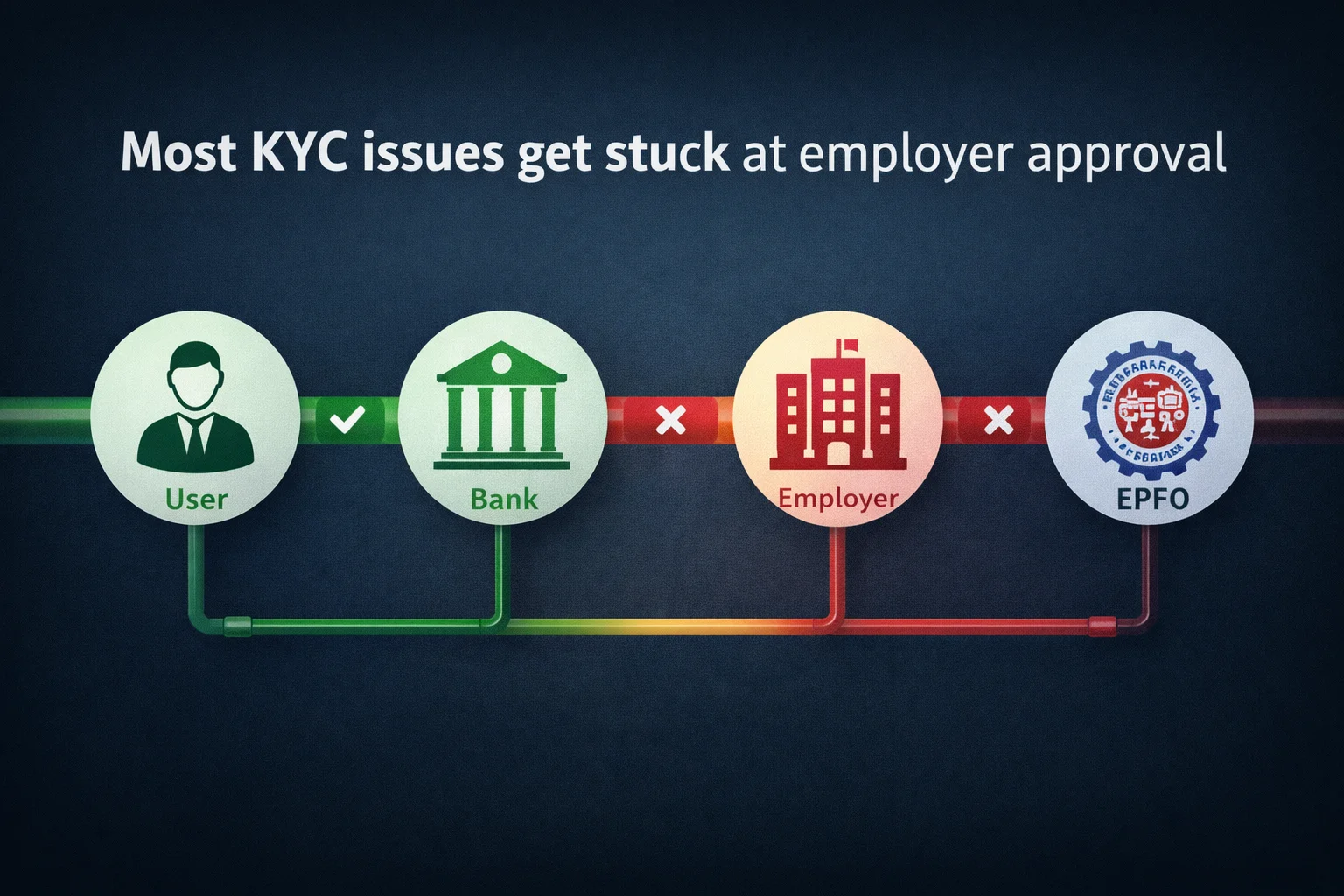
7. Why Your KYC Is Stuck (Employer-Side Issues)
In many cases, the problem is not with your details—it’s on the employer’s side. However, the EPF system does not clearly show this, and the status simply appears as “pending” or “not approved.”
Here are some common employer-side reasons that can block your KYC approval:
DSC (Digital Signature Certificate) Expired
Employers approve KYC using a Digital Signature Certificate (DSC). If this certificate has expired, the system may not process approvals—even though everything appears normal. This often results in your request staying “pending” indefinitely. You can also ask your HR team to confirm whether their Digital Signature Certificate (DSC) is active on the Unified Portal, as expired certificates can block approvals.
Authorized Signatory Is Inactive
In many organizations, the person responsible for approving EPF requests may have left the company or changed roles. If the approval request is assigned to that inactive account, it remains unprocessed without any visible error.
Transition Between Signing Systems
Some employers switch between DSC-based approval and e-sign systems. During this transition, approval workflows can break or fail silently.
These issues are not visible to users, which is why many people repeatedly update their details without success. If your details are correct but approval is still pending, the issue is likely on the employer side.
How to Follow Up with Your Employer
If your request is pending, you can reach out to your HR or admin team and ask them to check:
- KYC approval status in the Unified Portal
- Whether their DSC is active
- Whether the authorized signatory has access
8. Why Is My KYC “Pending for Approval” for So Long?
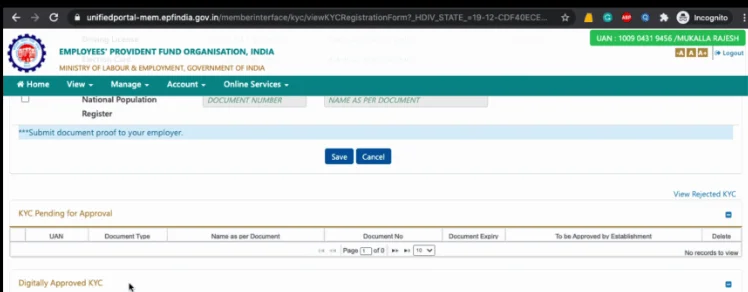
One of the most common frustrations is seeing the status remain unchanged for days or even weeks. A “pending for approval” status usually means that your request has been submitted but has not yet been completed in the system. Common reasons include:
- The employer has not reviewed the request yet
- Approval is blocked due to signature-related issues
- Bank verification is delayed or processed in batches
Public sector banks may take longer due to manual or batch processing, while some private banks process requests faster through automated systems. In such cases, the delay is not due to incorrect data but due to processing timelines across systems.
9. Why KYC Issues Cause PF Claim Rejection
EPFO processes claims only after all required details are verified and approved. If any part of the KYC layer is incomplete, the system cannot proceed with the transfer. This includes:
- Identity verification (Aadhaar)
- Bank account validation
- Approval status within the system
Even if your claim form is correctly filled out, it will not move forward unless these checks are completed. This is done to ensure that funds are transferred to the correct account and to prevent errors or misuse.
10. Quick Fix Table for KYC Issues
If you want a quick reference, the table below summarizes the most common issues and how to resolve them:
| Issue | Cause | Fix |
|---|---|---|
| KYC not verified | Aadhaar or a bank is not approved | Complete verification |
| Bank not approved | Employer approval pending | Follow up or update details |
| IFSC error | Incorrect bank details | Correct and resubmit |
This table can be used as a quick checklist before reapplying your claim.
11. Before You Reapply: KYC Checklist
Before submitting your claim again, take a moment to verify the following:
- Aadhaar is linked and verified
- The bank account is approved
- Name matches across EPF and bank records
- Employer approval (if required) is completed
Skipping any of these can result in another rejection, even if the main issue has been fixed.
12. When KYC Fix Doesn’t Work
In some cases, even after updating details, the issue may persist. This usually happens when the problem lies outside your direct control.
Common scenarios include:
- Employer is inactive or unresponsive
- The bank repeatedly rejects verification
- Data mismatch exists across multiple systems
If your issue is not resolved after updates:
- Raise a complaint via the EPF grievance portal (EPFiGMS)
- Select “KYC related” under the Member category
- Mention if employer approval is pending
- Track whether it is assigned to a nodal officer within ~48 hours
This allows EPFO to review and resolve the issue manually.
FAQs on EPF KYC Issues
Q. Why is my EPF KYC showing “pending with employer”?
This usually means your KYC request has been submitted but not yet approved by your employer. The delay can occur if the employer has not reviewed the request or if there are issues with their approval system.
Q. Can bank verification fail even if my details are correct?
Yes. In some cases, banks may reject verification requests due to inactive accounts, restricted KYC status, or internal validation issues. You may need to reactivate your account or confirm details with your bank.
Q. Does KYC need employer approval in all cases?
Not always. Aadhaar-based verification may be completed automatically, but bank details often require employer approval depending on the system setup.
Q. What happens if my KYC is not approved, but I apply for withdrawal?
Your claim will not be processed and may be rejected. EPFO requires all verification steps to be completed before releasing funds.
Q. Can I reapply immediately after fixing KYC issues?
Yes. Once your details are verified and approved, you can reapply your claim without waiting. Most successful claims happen after correcting the underlying issue.
Q. Why does my KYC status change, but the claim is still rejected?
This can happen if the claim was submitted before verification was completed or if there are additional issues beyond KYC, such as employment records or approval delays.
Q. Is Aadhaar mandatory for EPF KYC verification?
In most cases, Aadhaar is required for identity verification and seamless claim processing. Without Aadhaar linkage, verification may remain incomplete.
Q. What if my employer is not responding to KYC approval requests?
If your employer does not approve your KYC, you can follow up directly or raise a grievance through EPFiGMS to escalate the issue.
Summary: Fix KYC → Reapply Your Claim
If your EPF claim is rejected due to a validation issue, the process to resolve it is usually straightforward once the exact problem is identified.
- Identify the issue based on your status or error message
- Fix the verification or approval step
- Reapply your claim
- Track the status until settlement
Most claims are successfully processed after the underlying issue is corrected. If you're unsure why your claim was rejected, start with our EPF claim rejection guide
If your case involves multiple approvals or repeated failures, resolving it can take time—getting expert help can simplify the process and avoid further delays.
Disclaimer: This guide is for informational purposes based on common EPFO processes and user scenarios. KYC approval and claim outcomes may vary depending on your records, employer actions, and EPFO system updates. Always verify details on the Unified Portal (UAN) or consult EPFO support for official guidance.
![Why E-Khata Applications Get Rejected in Bangalore (And How to Fix Them) [2026]](/_next/image?url=https%3A%2F%2Fwebsite-assets-wix.s3.ap-south-1.amazonaws.com%2Fimages%2Fposts%2F3031ceb9f0274289aad5c5f140be716f.webp&w=828&q=75)