Many people feel relieved once their EPF withdrawal is approved, until they notice that a portion of their money has been deducted as tax.
This often happens without warning. The amount credited is lower than expected, and suddenly, questions start piling up:
- Why was TDS deducted?
- Was I supposed to submit something?
- Can this be avoided?
This is where Form 15G and Form 15H come in. They exist to prevent unnecessary tax deductions when your income legally falls below the taxable limit. Unfortunately, they’re also among the most misunderstood EPF-related forms.
This guide is meant to remove that confusion and help you make informed, calm decisions.
What Are Form 15G and Form 15H?
Form 15G and Form 15H are self-declaration forms submitted to prevent Tax Deducted at Source (TDS).
They tell the deductor, in this case, EPFO, that:
- Your total income for the financial year is below the taxable limit, and
- You do not expect to pay income tax for that year.
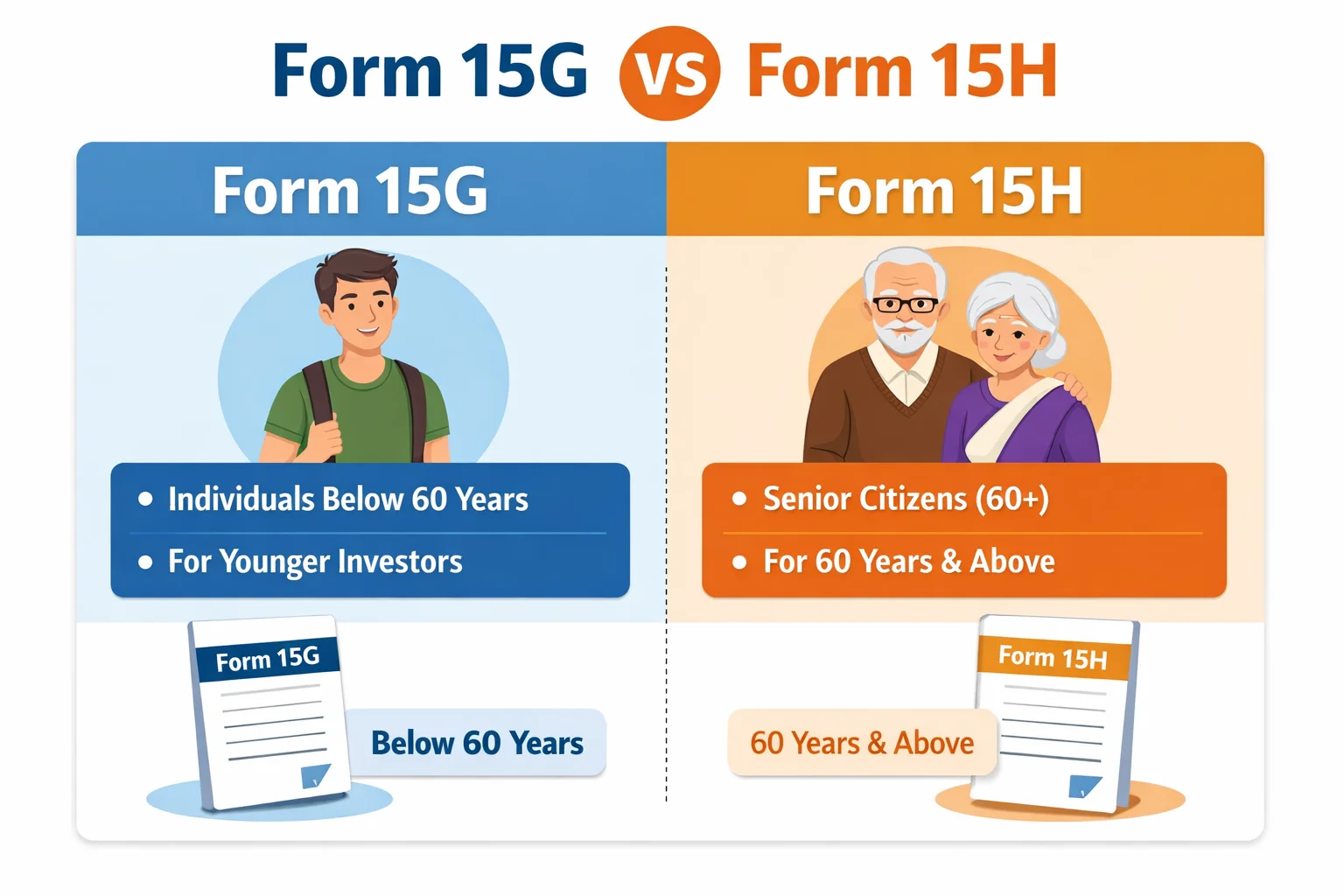
The Key Difference
| Form | Who Can Submit |
| Form 15G | Individuals below 60 years |
| Form 15H | Senior citizens (60+) |
Why TDS Is Deducted on EPF Withdrawals
TDS on EPF withdrawals is governed by income tax rules, not EPFO discretion.
TDS is usually deducted when:
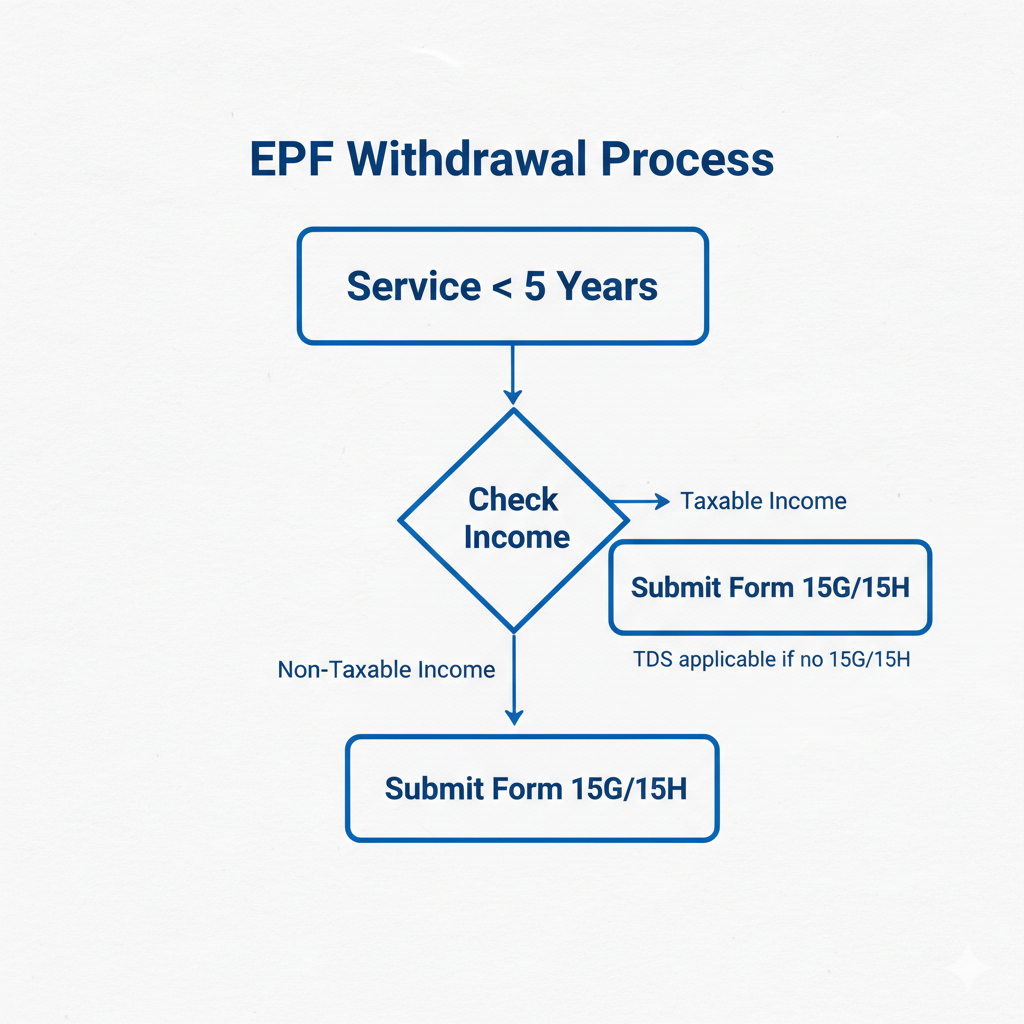
- PF is withdrawn before completing 5 years of continuous service, and
- The withdrawal amount exceeds ₹50,000
In such cases, EPFO is required to deduct tax unless a valid Form 15G or 15H is submitted.
Important: Completing 5 years of service (including transfers) generally makes EPF withdrawals tax-free.
For exemptions, VPF treatment, and post-5-year tax rules, see our complete EPF & PF Taxation India 2026 guide.
When Form 15G / 15H Is Applicable for EPF
You may need Form 15G or 15H if all the following apply:
- Your EPF withdrawal is before 5 years of service.
- Withdrawal amount is ₹50,000 or more.
- Your total taxable income for the year is below the exemption limit.
Income Limits You Must Understand
Eligibility depends not just on PF amount but on total income.
Current Basic Exemption Limits (Indicative)
| Category | Income Limit |
| Individual (<60 yrs) | ₹2.5 lakh |
| Senior Citizen (60–80) | ₹3 lakh |
| Super Senior (80+) | ₹5 lakh |
Note: These limits exclude deductions under Section 80C, 80D, etc., for Form 15G eligibility.
This is where many people make mistakes by assuming the PF amount alone determines eligibility.
4 Common Situations Where Form 15G Helps
- Job loss and PF withdrawal during a low-income year
- Career breaks or education gaps
- Early-career exits with limited earnings.
- Homemakers withdrawing old PF balances
Before submitting Form 15G, it helps to calculate your total income for the year, not just PF.
Not sure which form applies to you? Get a free EPF audit to check eligibility and avoid TDS or claim rejections.
How to Submit Form 15G / 15H Online
Most EPF claims today allow online submission and filling of Form 15G
High-Level Process (Online)
- Log in to the EPFO Member Portal
- Initiate PF withdrawal claim.
- Upload Form 15G (PDF) and PAN
- Submit the declaration digitally.
For a complete claim filing walkthrough, including Aadhaar OTP verification and form selection, refer to our EPF Withdrawal Process 2026 step-by-step guide.
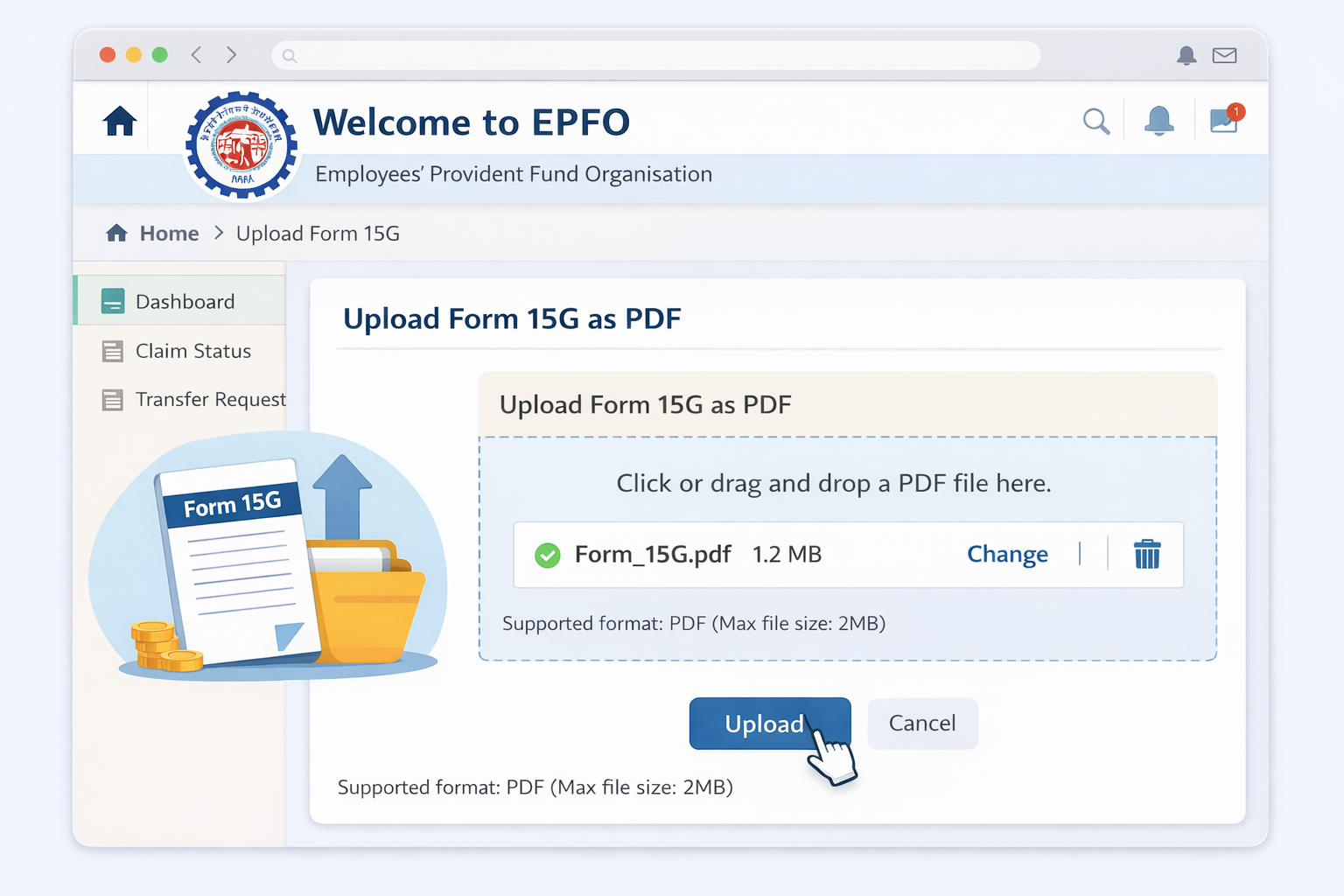
To fill EPF Form 15G/15H online, you generally follow a "Download → Fill → Upload" process. You cannot type directly into a web form on the EPFO portal; instead, you must download the blank form, fill it (digitally or by hand), convert it to PDF, and then upload it while filing your claim.
Here is the step-by-step guide to filling it correctly to ensure your claim isn't rejected.
Phase 1: Eligibility Check
Before filling it, confirm you actually need it. You only need Form 15G if all three conditions are met:
- You are withdrawing EPF before 5 years of service.
- The withdrawal amount is more than ₹50,000.
- Your total taxable income (including this EPF amount) is below the basic exemption limit (₹2.5 Lakh or ₹3 Lakh, depending on your tax regime).
Note: If you are 60+ years old, you must use Form 15H instead
Phase 2: How to Fill Form 15G (Part 1)
You only need to fill Part 1 of the form. Leave Part 2 blank (it is for the EPFO office)
| Field No. | Field Name | What to Enter |
| 1 | Name of Assessee | Your full name (exactly as per PAN Card). |
| 2 | PAN of the Assessee | Your valid PAN card number. |
| 3 | Status | Write "Individual". |
| 4 | Previous Year | Write the current Financial Year (e.g., if filing in Jan 2026, write 2025-2026). |
| 5 | Residential Status | Write "Resident". |
| 6-12 | Address Details | Fill in your permanent address (match with Aadhaar if possible). |
| 13-14 | Email & Phone | Enter a valid email ID and your registered mobile number. |
| 15 (a) | Whether assessed to tax? | Tick "Yes" if you have filed IT Returns in the past; otherwise, No". |
| 15 (b) | Latest Assessment Year | If you ticked "Yes" above, write the latest year you filed returns for (e.g., 2025-26). |
| 16 | Estimated income for which this declaration is made | Enter the exact EPF withdrawal amount (Employee Share + Employer Share). Do not include the pension amount. |
| 17 | Estimated total income... | Enter your Total Annual Income for the current year, PLUS the EPF amount from Field 16. |
| 18 | Details of Form 15G other than this form... | If you submitted Form 15G elsewhere (like to a bank for FD interest), mention the count. If not, write "Nil". |
| 19 | Details of income for which the declaration is filed | Sl. No: 1Identification No: Your UAN NumberNature of Income: "EPF Withdrawal"Section: "192A"Amount of Income: Same amount as Field 16. |
Phase 3: How to Upload on EPFO Portal
Once you have the filled form saved as a PDF (max size 1MB):
- Log in to the EPFO Unified Portal.
- Go to Online Services > Claim (Form 31, 19, 10C & 10D).
- Enter your Bank Account Number and click Verify.
- Select the relevant claim (usually Form 19 for final settlement).
- You will see a section: "Upload Form 15G/15H".
- Click Choose File, select your filled PDF, and upload it.
- Proceed to validate via Aadhaar OTP and submit your claim.
3 Common Mistakes to Avoid
- Wrong Assessment Year: Remember, Financial Year is the current running year (e.g., 2025-26), while Assessment Year is the following year (e.g., 2026-27).
- Pension Withdrawal: Do not include your Pension Fund (Form 10C) amount in the calculations. Form 15G does not apply to pension withdrawals.
- Blurry Scan: Ensure the uploaded PDF is readable. The system of Pension withdrawals follows separate EPS rules, which may reject it. You can read more in our detailed Form 10C in the EPF guide.
How to Fill Form 15H (Step-by-Step)
Personal Details
- Name – As per PAN
- PAN – Mandatory (must match EPFO records)
- Status – Individual
- Previous Year – Example: 2025–26
- Residential Status – Resident
- Address & Email ID – Enter current details
Income Details
- Estimated Total Income – Include EPF withdrawal, pension, interest, etc.
- Total Income of Previous Year – Last year’s income
- Income for Which TDS Is Not to Be Deducted
- Total Income Including This Income – Same as estimated income
Declaration
- Tick the declaration confirming tax liability is NIL
- Add Place, Date, and Signature / Thumb Impression
Important EPF Rules to Remember
- Form 15H is required only if:
- If Form 15H is not submitted → TDS @10%
- If PAN is missing → TDS @30%
How to Submit Form 15H
- Online: Upload while applying for EPF withdrawal through the UAN portal
- Offline: Attach Form 15H with PF withdrawal forms and submit to EPFO
Steps to Fill the Form Offline
- Get the form from your bank, post office, or download & print from the income tax website.
- Enter Personal Details
- Fill Income Details
- Declaration & Signature
- Submit to Bank / Institution
Important Conditions
- Submit Form 15G → Only if age < 60 and total income is below the followstaxable limit.
- Submit Form 15H → For senior citizens, even if interest exceeds ₹50,000 (but tax liability must be zero).
- Must be submitted every financial year and separately at each branch where interest is earned.the
PAN Is Mandatory (No Exceptions)
If PAN is not linked or submitted, EPFO may deduct TDS at a higher rate.
This is one of the most common reasons people lose money unnecessarily.
| PAN Status | TDS Impact |
| PAN linked & 15G valid | No TDS |
| PAN linked, no 15G | Standard TDS |
| PAN not linked | Higher TDS |
5 Common Mistakes That Lead to TDS Anyway
Even after submitting Form 15G/15H, TDS may still be deducted due to:
- Incorrect assessment year selected.
- Income exceeding the exemption limit.
- Mismatch in PAN details
- Incomplete form upload
- Late submission (after claim processing)
A quick review before submission can prevent irreversible deductions. Book a free call with our experts to review your EPF.
What If TDS Is Already Deducted?
If TDS has already been deducted:
- You can claim a refund while filing your Income Tax Return (ITR)
- The refund is processed by the Income Tax Department, not EPFO.
This process takes time and often causes frustration, another reason prevention matters.
How This Fits Into Your EPF Withdrawal Decision
Form 15G / 15H is not a standalone step. It depends on:
- Your service history
- Type of EPF claim (final settlement, partial withdrawal)
- Your income for the year
Many people submit it blindly or skip it entirely, leading to avoidable financial loss.
Understanding when it applies is more important than knowing how to upload it.
Frequently Asked Questions (FAQs)
1. Is Form 15G compulsory for EPF withdrawal?
No, it’s not mandatory. It is only needed if you want to avoid TDS on your EPF withdrawal and meet the eligibility criteria.
2. Can I submit Form 15G after withdrawal?
No, it must be submitted before or during the EPF claim process. Submitting afterwards will not stop TDS deductions.
3. Does submitting Form 15G guarantee no tax?
Only if your declaration is valid and your total income is below the taxable limits. An incorrect submission may still attract TDS.
4. What if my income crosses the limit later?
You may need to pay tax while filing your ITR for that financial year. Form 15G does not cover future income changes.
5. Can senior citizens use Form 15G?
No, individuals aged 60 or above must use Form 15H to declare non-taxable income and avoid TDS.
6. Does Form 15G apply after 5 years of service?
Generally, no, because EPF withdrawals are tax-free after 5 years of continuous service. Form 15G is only relevant before that.
7. Can I submit Form 15G for partial EPF withdrawal?
Yes, you can submit it for partial withdrawals like housing, education, or medical expenses, if eligible.
8. How many times can I submit Form 15G in a year?
There is no strict limit, but it must be submitted for every claim or interest payout where you want a TDS exemption.
9. What documents are needed with Form 15G?
Typically, you need PAN card details, EPF account number, and proof of income. Check your EPFO portal for specific requirements.
10. What happens if Form 15G is rejected?
If rejected, TDS may be deducted from your withdrawal. You can rectify the form and resubmit or claim a refund via ITR.
Conclusion: Use Form 15G / 15H Carefully, Not Fearfully
Form 15G and 15H are safeguards, not shortcuts. They exist to protect people from unnecessary tax deductions during already stressful financial transitions.
Most mistakes happen not because people try to do something wrong, but because they don’t have clarity on eligibility, income limits, or timing. Taking a few minutes to review your service period and annual income can make a significant difference to how much money actually reaches you.
For personalised guidance and to ensure your EPF withdrawal is TDS-free and hassle-free, book a free call with Kustodian today. Our experts will review your case, verify eligibility, and guide you step-by-step.
Book your call now and avoid delays or mistakes in your EPF claims.
Disclaimer
This article is for informational purposes only and does not constitute legal or financial advice. Tax rules, exemption limits, and EPFO processing may vary based on individual records and applicable laws.