
For many Non-Resident Indians (NRIs), the Employee Provident Fund (EPF) is a significant financial asset left behind in India. However, as the years pass, the process of claiming this money can feel like a bureaucratic nightmare, especially when the "easy" online route fails.
If you are residing in the USA, UAE, UK, Australia, or elsewhere, and you’ve realised your Aadhaar isn't linked, your old Indian mobile number is dead, or your UAN is "inoperative," you might be feeling a sense of panic.
The good news: You do not need to fly back to India to claim your funds. The Embassy Attestation Route is the legally recognised "offline" bridge designed specifically for overseas citizens to execute their claims from abroad. This guide provides a comprehensive, step-by-step roadmap for 2026 to help you navigate the Indian Embassy/Consulate process and finally bring your EPF savings home.
Contents
Introduction
1. “I’m Outside India, How Can I Withdraw My EPF?”
2. When the Embassy Attestation Route Is Required for EPF Withdrawal for NRIs
3. What “Embassy Attestation” Actually Means
4. Forms Required for EPF Withdrawal From Abroad
5. Taxation for NRIs in 2026 (The Section 192A/195 Update)
6. Step-by-Step: EPF Withdrawal From Abroad (2026)
7. How Long Does It Take?
8. Common Reasons for Rejection
9. Repatriating the Money (Bringing it to your Foreign Bank)
10. When to Get Expert Help (Kustodian Life)
11.Frequently Asked Questions
1. “I’m Outside India, How Can I Withdraw My EPF?”
The most common fear for NRIs is the "physical presence" trap. In 2026, while India has digitised most services, legacy accounts often require a human touch.
- Do I need to fly back to India? No.
- Will EPFO accept documents mailed from overseas? Yes, provided they are verified by an authorised Indian Mission (Embassy/Consulate).
- Is embassy attestation compulsory? For offline claims where you cannot receive an Aadhaar OTP, it is the gold standard.
Immediate Reassurance
NRIs can successfully withdraw their EPF without visiting India. The process involves physical forms, a visit to your local Indian Consulate (or a VFS Global
centre in 2026, and a courier to the specific EPFO office in India where your account is held.
Boundary Clarity:-
This is an offline process. Under the “current EPFO digital framework”, if you can access the EPFO Unified Portal with an active Aadhaar-linked OTP and your "Date of Exit" is marked as "Settled Abroad," you should use the online route, which now settles in as little as 3–7 days. Use this guide only if the digital door is locked for you.
2. When the Embassy Attestation Route Is Required for EPF Withdrawal for NRIs
Identify if you fall into the "Offline/Embassy" category. This route is mandatory or highly recommended if:
- Aadhaar & Mobile Issues: Your Aadhaar is not linked, or you no longer have access to the Indian SIM required for OTPs.
- Legacy "Inoperative" Accounts: Your account has had no contributions for 36+ months.
- Manual Corrections: You need a Joint Declaration to fix errors in your name or Date of Exit.
Hard Stop: If your Aadhaar e-sign is working, stop here and use the online portal. The embassy route is a "manual gear" process for complex cases.
2026 Update
Interest Credit for NRIs: While EPF interest generally accrues until the age of 58 for resident members, in many cases, where a member has permanently settled abroad, and the account remains inactive for several years, the EPFO has stopped crediting interest in practice.
This is assessed on a case-by-case basis and is not uniformly applied across all accounts. If your passbook shows that interest entries have ceased, it is advisable to initiate withdrawal or transfer promptly to avoid further opportunity cost.
"If your account has been dormant for years, it may be part of the ₹8,500 Cr unclaimed pool. Read our guide on Recovering Inoperative and Unclaimed EPF Accounts to see how to reactivate them."
3. What “Embassy Attestation” Actually Means
In the eyes of the EPFO, they are releasing a large sum of money to someone they cannot see. Since they cannot use a digital "Aadhaar fingerprint," they rely on the Indian Embassy or Consulate to act as the authorised verifier.
What the Attestation Confirms:
- Identity: The Consular Officer verifies your original Indian Passport.
- Signature: You must sign the EPF forms in the presence of the officer.
- Address: Your overseas residency is confirmed via your visa or local ID (e.g., Emirates ID, Green Card).
Important Note: A local Notary Public in your country (e.g., a US Notary) is often rejected by EPFO. They specifically look for the round seal of the "Embassy of India" or "Consulate General of India."
4. Forms Required for EPF Withdrawal From Abroad
You must use the Composite Claim Form (Non-Aadhaar). This is the specific version designed for manual processing and attestation.
The Essential Documentation Packet:
- Composite Claim Form (Non-Aadhaar): Choose "Final Settlement" (Form 19) and "Pension Withdrawal" (Form 10C) if you have less than 10 years of service.
- Form 10D: If you have more than 10 years of service, you are eligible for a monthly pension instead of a lump sum.
- PAN Card Copy: Crucial for tax purposes.
- Joint Declaration Form: Only if there are errors in your basic profile.
- Copy of Passport & Visa: Attested by the embassy.
- Bank Proof: A cancelled cheque or an attested bank statement of your NRO Account.Note: EPF cannot be credited to an NRE or foreign bank account.
"NRIs often forget that PF and Pension are two separate pots. Ensure you don't leave your pension money behind by following our Form 19 vs 10C Comparison Guide."
5. Taxation for NRIs in 2026 (The Section 192A/195 Update)
Taxation for NRIs is fundamentally different from that of resident Indians. In 2026, the ₹50,000 threshold applies, but the rates under Section 195 are strict:
| Service Tenure | Tax Status | TDS Rate (with PAN) | TDS Rate (No PAN) |
| 5+ Years | Tax-Free | 0% | 0% |
| < 5 Years | Taxable | 30% + Cess* | 34.608% |
Note: For NRIs, the TDS rate is often flat 30% under Section 195 unless you provide a Tax Residency Certificate (TRC) to claim DTAA benefits.
Pro-Tip: NRIs cannot submit Form 15G/15H. These are for residents only. Using them will result in claim rejection or potential tax penalties later.
Crucial 2026 Compliance Notes:
- Section 195 vs. 192A: Unlike residents who pay 10% TDS, NRIs are often taxed at the maximum marginal rate of 30% (plus 4% cess) under Section 195 because the withdrawal is classified as "income accruing in India" for a non-resident.
- DTAA Benefit: You can reduce this 30% rate by claiming benefits under the Double Taxation Avoidance Agreement (DTAA). To do this, you must submit a Tax Residency Certificate (TRC) from your current country and Form 10F along with your claim.
- Form 15G/15H Prohibited: These forms are for Residents only. If an NRI submits these, the claim will be rejected for "status mismatch," or you may face penalties for misrepresentation.
TDS for NRIs
Once a member’s status is correctly recorded as a Non-Resident, EPF withdrawals made before completing 5 years of service are generally subject to tax under Section 195, often at the maximum marginal rate applicable to NRIs.
However, NRIs may be eligible for a lower tax rate under the applicable Double Taxation Avoidance Agreement (DTAA) by submitting a valid Tax Residency Certificate (TRC) and Form 10F.
The final TDS rate depends on the specific tax treaty between India and the country of residence and is not a fixed or guaranteed percentage.
6. Step-by-Step: EPF Withdrawal From Abroad (2026)
Step 1: Fill the Forms Correctly
Download the latest forms from the EPFO website. Ensure your UAN and Member ID match your last EPF slip. Under "Reason for Leaving," you must write "Settling Abroad" to bypass the 2-month waiting period.
Step 2: Book an Appointment (The VFS/Consulate Shift)
In 2026, the process is streamlined but rigid. You cannot simply walk in.
- USA/UK/Canada: You must book through VFS Global. Select "Miscellaneous Consular Services" and specifically choose "Attestation of Documents."
- UAE: Visit IVS Global or designated BLS centres.
- The "Gold Standard" Seal: Ensure the officer places the Consular Round Seal on your Composite Claim Form AND your bank proof. A local "Notary Public" (like a US mobile notary) is almost always rejected by EPFO.
- https://www.epfindia.gov.in/site_en/Location
VFS Appointment Tip: In the USA and UK, book under "Miscellaneous Services -> Attestation." Crucially, bring a pre-paid self-addressed courier envelope (FedEx/UPS) to the VFS centre, as they will often mail the attested documents back to your home address rather than handing them over immediately.
Step 3: In-Person Appearance & Attestation
You must appear in person. The officer will witness your signature on the EPF forms and the Passport/Visa photocopies. Ensure you get the Consular Seal on the bank proof (cancelled cheque/statement) as well.
Step 4: Prepare the Submission Packet
Your "Golden Envelope" should contain:
- Original attested Claim Forms.
- Attested copy of Passport/Visa.
- Cancelled the original NRO cheque.
- A Covering Letter addressed to the "Regional Provident Fund Commissioner" explaining your NRI status.
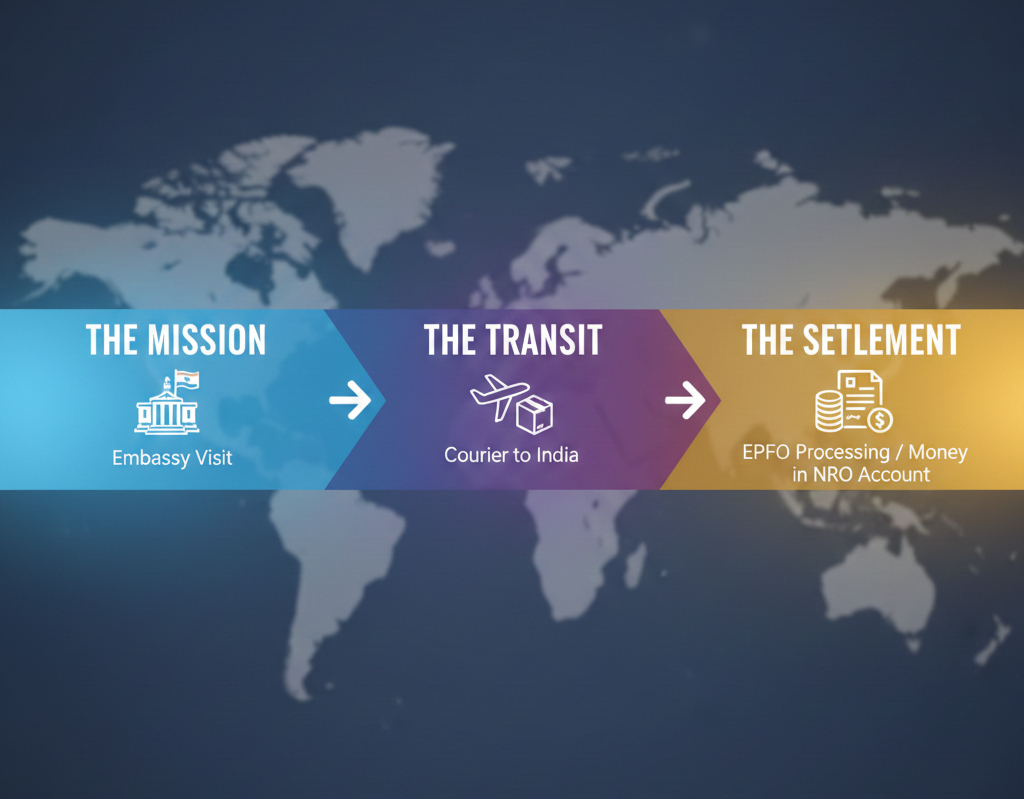
Step 5: Courier to India
Courier the packet to the Regional EPFO Office where your last employer was registered (e.g., EPFO Bengaluru, EPFO Gurgaon). Use a tracked service like DHL or FedEx.
7. How Long Does It Take?
The embassy route is a test of patience. Unlike online claims, the manual route involves transit and manual entry.
- Embassy Attestation: 1–5 days (depending on appointment).
- International Courier: 3–5 days.
- EPFO Internal Processing: 30–60 days.
- Total Expectation: 2 to 3 months from the day you visit the embassy.
8. 4 Common Reasons for Rejection
- Wrong Bank Account: Attempting to credit the money to an NRE account.
- Signature Mismatch: Your 2026 signature doesn't match the one from 10 years ago. (Fix: Submit an attested "Signature Verification" from your bank.
- Missing Date of Exit: If your employer didn't mark you as "Left Service," the claim will fail.
- Using a Local Notary: A US/UK Public Notary is generally not accepted; it must be the Indian Consulate.
"A minor spelling difference between your Passport and EPF records is the #1 cause of manual rejection. See how we fixed this for a client in our KYC Correction Case Study."
9. Repatriating the Money (Bringing it to your Foreign Bank)
Once the money reaches your NRO account, it is still in India. To transfer it to your local bank (USA, UK, etc.), you will need:
- Form 15CA: A self-declaration filed on the Income Tax portal.
- Form 15CB: A certificate from a Chartered Accountant (CA) in India certifying that taxes have been paid.
- Form A2: Provided by your bank for outward remittance.
"Getting the money into your NRO account is only half the battle. To move it to your local bank abroad, you’ll need to navigate FEMA rules. Check out our 15CA/CB Tax Compliance Guide to complete the transfer."
10. When to Get Expert Help (Kustodian Life)
Navigating Indian bureaucracy from 10,000 miles away is exhausting. Kustodian Life acts as your "feet on the ground" in India. We specialise in helping NRIs with:
- Tracing Old Accounts: Finding PF numbers from defunct companies.
- Liaising with EPFO: Our experts visit Regional Offices to resolve "stuck" claims.
- Correction Management: Handling the end-to-end Joint Declaration process.
- Tax Coordination: Assisting with 15CA/15CB for full repatriation.
"We don't just give advice; we manage the follow-ups so you don't have to." Before you spend money on international couriers, ensure your account isn't flagged for hidden errors. Run a Free EPF Audit to get a full health report on your UAN and identify potential rejection risks in under 2 minutes.
Useful Links & Official Resources
Official EPFO Portals
- Employees' Provident Fund Organisation Official Websitehttps://www.epfindia.gov.inThe main portal for all EPF services, claim forms, passbook access, and member services.
- EPFO Unified Member Portal (UAN Services)https://unifiedportal-mem.epfindia.gov.inLogin to check your UAN status, KYC details, and submit online claims.
- Know Your EPF Office Locationhttps://www.epfindia.gov.in/site_en/LocationFind the regional EPFO office where your PF account is maintained.
- EPFiGMS Portal (EPF Grievance Portal)https://epfigms.gov.inLodge complaints or track claim issues if your PF withdrawal is delayed.
EPF Forms & Download Links
These are the most important forms for offline EPF withdrawal from abroad.
- Composite Claim Form (Non-Aadhaar) – For offline withdrawal without Aadhaar OTPhttps://www.epfindia.gov.in/site_docs/PDFs/Downloads_PDFs/Composite_Claim_Form_NonAadhaar.pdf
- Form 19 (PF Final Settlement)https://www.epfindia.gov.in/site_docs/PDFs/Downloads_PDFs/Form19.pdf
- Form 10C (EPS Withdrawal Benefit)https://www.epfindia.gov.in/site_docs/PDFs/Downloads_PDFs/Form10C.pdf
- Form 10D (Monthly Pension Claim)https://www.epfindia.gov.in/site_docs/PDFs/Downloads_PDFs/Form10D.pdf
- Joint Declaration Form for EPF Correctionshttps://www.epfindia.gov.in/site_docs/PDFs/Downloads_PDFs/Joint_Declaration_Form.pdf
The Composite Claim Form (Non-Aadhaar) replaces older withdrawal forms and is used when Aadhaar or bank details are not linked to UAN.
Embassy & Consular Attestation
If you are withdrawing EPF from outside India, these portals help you book attestation appointments.
- VFS Global Consular Services Portalhttps://visa.vfsglobal.com
- Embassy of India Directoryhttps://www.indianembassy.gov.inLocate the Indian embassy or consulate in your country.
Tax & Repatriation Resources
These links help NRIs handle taxation and transfer the money abroad.
- Income Tax Department of India Portal https://www.incometax.gov.in
- Form 10F Download (DTAA Claim for NRIs)https://www.incometax.gov.in/iec/foportal/help/downloads/income-tax-forms
- Tax Residency Certificate (TRC) Guidance https://www.incometax.gov.in/iec/foportal/help/how-to-file-return
Helpful Government Apps
- UMANG App (Unified Mobile Application for New-age Governance)https://umang.gov.inThrough UMANG you can:
Tracking Your Claim
Once your documents reach the EPFO office, use these tools:
- EPF Claim Status Trackerhttps://passbook.epfindia.gov.in
- EPFiGMS Grievance Trackerhttps://epfigms.gov.in
- EPFO Helpline14470 (India)
Q: Can I withdraw my EPF immediately after moving abroad?
A: Yes. While resident Indians must wait 60 days after leaving a job, NRIs are exempt from this waiting period. By selecting "Settling Abroad" as your reason for exit, the current EPFO digital framework system allows for an immediate final settlement.
Q: My account hasn't had contributions for 5 years. Is it still earning interest?
A: It depends. While EPF interest is generally credited up to age 58 for resident members, in practice, interest credit has ceased in many long-inactive accounts where the member has permanently settled abroad.
You should verify your passbook entries. If interest has stopped accruing, initiating withdrawal sooner can help you redeploy the funds into higher-yielding investments.
Q: I don't have my Indian mobile number anymore. How do I get the OTP?
A: If you cannot update your mobile number to an international one (a feature rolling out in phases in 2026), you cannot use the online portal. You must use the Composite Claim Form (Non-Aadhaar) and get it attested by the Indian Embassy to bypass the OTP requirement.
Q: Can I use a US or UK Notary instead of the Indian Consulate?
A: No. EPFO generally rejects local foreign notaries. They require the "Consular Seal" from an Indian Mission. In the USA, this is now handled via VFS Global miscellaneous services.
Q: Can I receive the money directly in my foreign bank account (e.g., Chase, HSBC UK)?
A: No. EPFO only credits funds to an NRO (Non-Resident Ordinary) account in India.
Q: Can I submit Form 15G/15H to avoid tax?
A: No. Form 15G/H is strictly for Resident Indians. NRIs who submit this risk claim rejection or legal scrutiny for misrepresentation. To reduce tax, you must apply for a Lower TDS Certificate from the Indian IT Department.
Q: Do I need to send my original Passport to the EPFO office in India?
A: Never. You only need to send a photocopy of your Passport and Visa, which must be attested (stamped and signed) by the Indian Embassy/Consulate.
Q: How do I track my offline claim?
A: Once your courier reaches the Regional PF Office, use your UAN to track the status via the EPFiGMS (Grievance) portal or the "Know Your Claim Status" link on the EPFO website.
Q: Can I get a lower TDS rate if I have less than 5 years of service?
A: Yes. By providing a Tax Residency Certificate (TRC) and Form 10F, you can leverage the DTAA treaty between India and your country (e.g., USA, UAE, UK) to potentially bring the TDS down from 30% to a lower treaty rate.
Conclusion
Withdrawing your EPF from abroad in 2026 is a matter of strict procedure. While the digital "Aadhaar" era has simplified things for many, the Embassy Attestation Route remains the vital lifeline for NRIs with legacy accounts or technical hurdles. By following this guide, you ensure that your hard-earned savings are not lost to the "Inoperative" void.


