You open your EPF passbook expecting to see interest added, but the balance hasn’t changed.
Naturally, the first question is: “Where is my PF interest?”
In 2026, most “missing PF interest” cases are not errors; they are timing delays in EPFO processing. You check your UAN portal, download your passbook, and stare at the numbers, wondering: “Where is my interest?”
If you are looking at your EPF passbook and seeing only your monthly contributions without any sign of the annual interest, you aren’t alone. In 2026, with digital systems faster than ever, the "delay" in interest reflection remains one of the most-searched-for queries among Indian employees.
This guide clarifies exactly how interest on PF accounts works, when the EPF interest credit date actually occurs, and how to interpret those cryptic entries in your digital passbook.
Quick Answer: Why EPF Interest Is Not Showing
EPF interest is calculated monthly but credited once a year. If your passbook does not show interest, it is usually due to:
- Delay in government interest notification
- EPFO batch processing
- Employer filing delays
- Passbook update lag
Your interest is not lost; it will be added once processing is complete.
EPFO Update: EPFO Holds Interest at 8.25% for FY 2025-26: A Win for Your Retirement Corpus
Contents
- My PF Interest Isn’t Showing, Is Something Wrong?
- How EPF Interest Works: The Foundation
- When Does EPF Interest Get Credited? (2026 Reality)
- Why EPF Interest Appears Late in the Passbook
- How to Read EPF Interest Entry in Your Passbook
- How Much Interest Do You Actually Earn?
- 3 Common EPF Interest Misunderstandings
- EPF Interest & Employment Status
- What to Do If EPF Interest Still Doesn’t Reflect
- Conclusion
- FAQs
1. My PF Interest Isn’t Showing, Is Something Wrong?
It is the start of a new financial year, and you log into the EPFO portal expecting a boost to your retirement corpus. Instead, you see the same closing balance from months ago. The panic starts to set in: Is my employer not depositing the money? Has the government forgotten my account? Is there a technical glitch?
First, take a deep breath. Interest hasn’t been credited yet for millions of others, too.
Common worries include:
- "The passbook shows an old balance:" You might see contributions up to the current month, but the "Interest Credited" row is missing.
- "Others got interest, I didn’t:" You might hear a colleague or a friend in a different city mention their interest is visible, while yours is not.
The Reassurance: EPF interest credit is a massive, batch-based administrative task. It is inherently time-lagged. A delay in the visibility of your interest does not mean a loss of interest. Your money is safe, and the interest is calculated as part of the annual credit process once the rate is notified.
Check PF Balance via EPFO Portal & Passbook (2026 Guide)
2. How EPF Interest Works: The Foundation
To understand the timing, you must first understand the mechanics. Many members assume the EPF works like a standard savings account where interest is earned every quarter or month. This is not the case.
- Annual, Not Monthly Credit: While your interest is calculated monthly, it is only credited to your account once per financial year (April to March).
- The Monthly Running Balance: The EPFO calculates interest on the "monthly running balance." This means they look at your closing balance at the end of every month, apply the proportional interest, and keep a running tally.
- Final Consolidation: The final credit happens as a single lump-sum entry once the financial year is closed and the government officially notifies the rate.
3. When Does EPF Interest Get Credited? (2026 Reality)
EPF interest is one of the most important components of your retirement savings, but many members are unsure about when it actually gets credited. While the interest is calculated throughout the year, the credit does not happen in real time. Understanding the timeline helps you avoid unnecessary confusion when your passbook doesn’t immediately reflect the update.
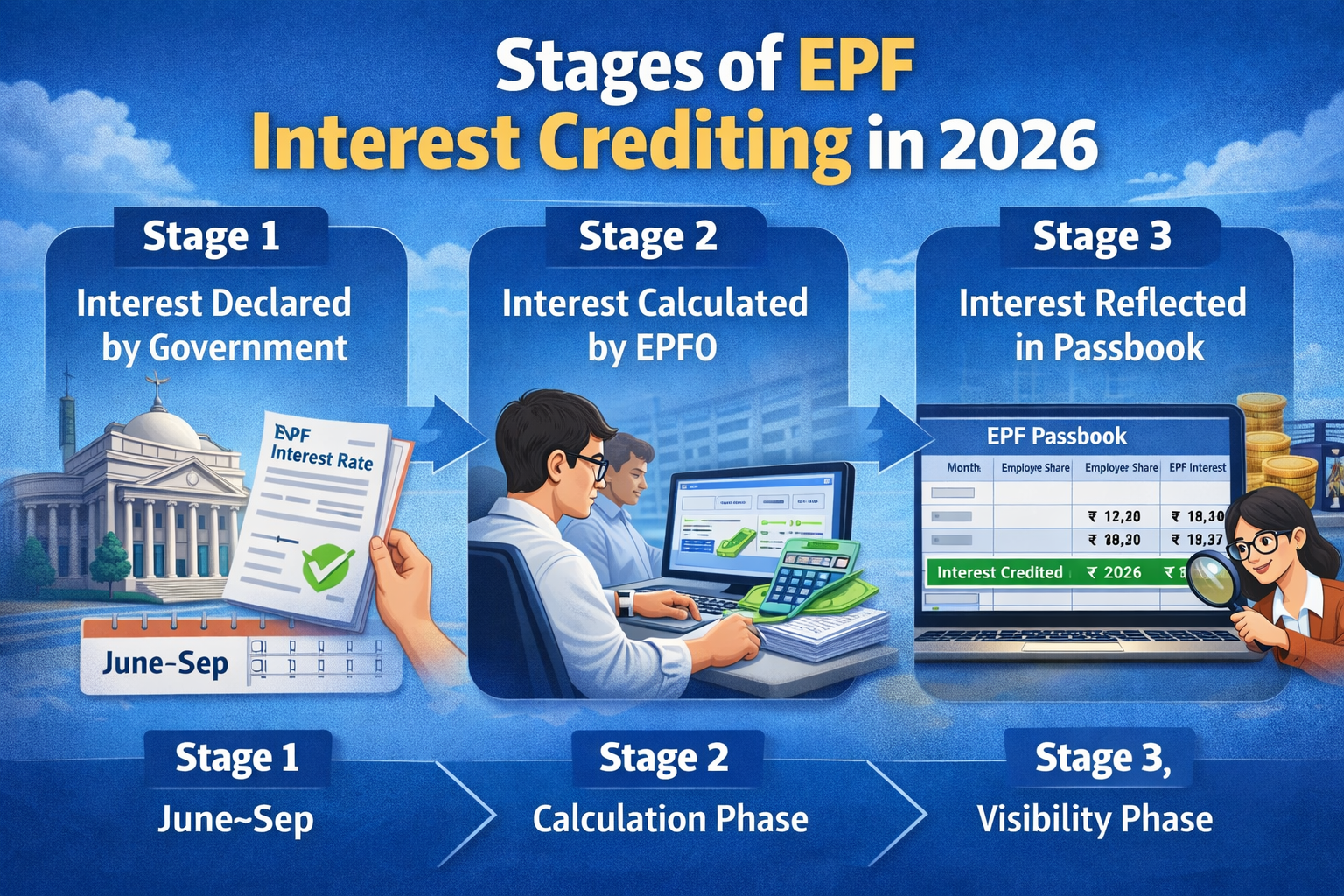
Stage 1: Interest Declared by Government
Every year, the CBT (Central Board of Trustees) recommends an interest rate, which must then be ratified by the Ministry of Finance. This usually happens in the mid-to-late quarters of the year.
Stage 2: Interest Calculated by EPFO
Once the rate is official, the EPFO software begins the mammoth task of calculating the specific interest for over 6 crore (60 million) active accounts. This is done based on the monthly balances maintained throughout the previous financial year.
Stage 3: Interest Reflected in Passbook
This is the "Visibility Phase." Even after the calculation is done, the data must be synced with the member passbook portal.
The 2026 Timeline: Declaration: Usually occurs between June and September.
- Passbook Reflection: Staggered and office-wise.
- Key Fact: The interest credit date is not the same for every member. Because the EPFO processes data in batches across hundreds of regional offices, your friend in Bengaluru might see their interest weeks before you do in Delhi.
4. Why EPF Interest Appears Late in the Passbook
If EPF interest is technically “earned” by March 31st, many members wonder why it sometimes takes until December or even later to reflect in their passbook.
The delay isn’t due to lost interest, but because of backend processing and compliance checks carried out by EPFO before final crediting.
- Backend Reconciliation: The EPFO must ensure that all Employer Contribution Returns (ECR) for the year are fully reconciled. If some employers are late in filing, it can slow down the batch processing for that specific region.
- Employer ECR Delays: If your company delayed a payment in, say, August, the system needs to resolve that gap before finalising the annual interest.
- Office-wise Batch Updates: The EPFO operates through various Regional Offices (ROs). The interest update process occurs in stages across EPFO systems independently once their data auditing is complete.
- System Sync Delays: In 2026, while the servers are robust, the sheer volume of traffic during "Interest Season" often leads to staggered updates to prevent portal crashes.
Important Reassurance: Even if your passbook doesn't show the entry for six months, you are not losing money. The interest is backdated. When it finally appears, it will be added as of interest is credited for the financial year ending March 31.
Read about EPF Interest Rate History & Balance Growth
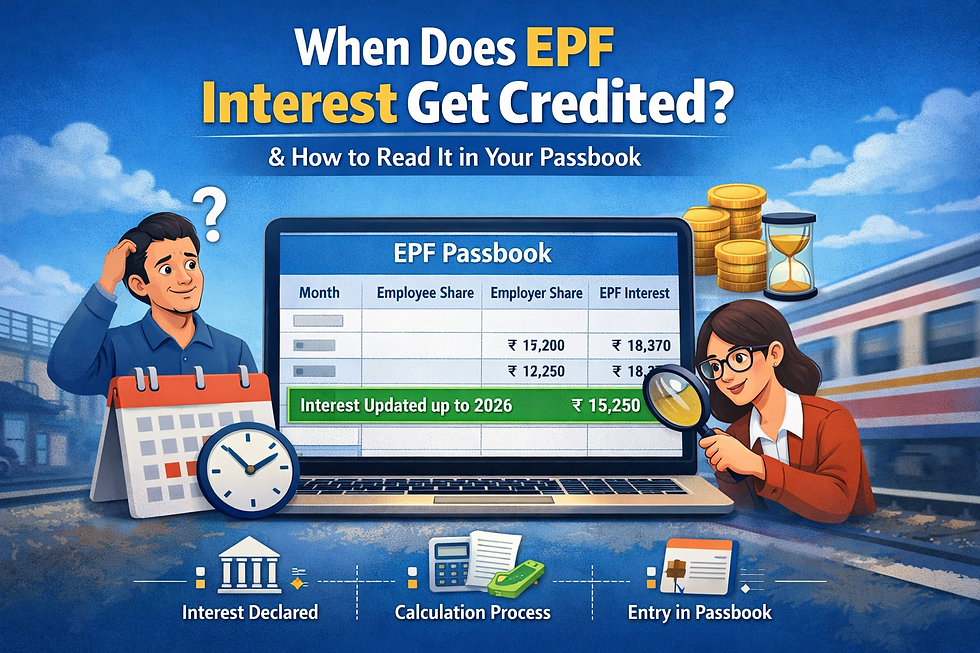
5. How to Read EPF Interest Entry in Your Passbook
When the interest finally arrives, it won't look like your monthly contribution rows. Here is how to spot it:
- Where it appears: Look at the end of the entries for a specific financial year. It usually appears as a consolidated entry after the March contribution.
- The Label: It is typically labelled as "Interest Updated up to [Year]" or "Int. Credited for [Year]."
- Consolidated Figure: You will see a single amount added to the "Employee Share" column and another to the "Employer Share" column.
What you won't see:
- No monthly interest rows: You will never see an entry like "Interest for July."
- No separate interest ledger: It is merged directly into your total corpus.
Note: No interest is credited to the EPS (Pension) contribution (the 8.33% part). Interest only accrues on the EPF portions (12% Employee + 3.67% Employer).
If you want to check your balance on the go, read about how to check your interest on the UMANG App.
6. How Much Interest Do You Actually Earn?
While everyone wants to know how much interest on PF they will get, the actual math is a bit more complex than simply multiplying your total balance by the interest rate.
The interest is calculated on the average monthly running balance.
The Math:- EPFO calculates interest on the annual running balance, applying interest on the opening balance for the full year and on contributions from the month following the deposit.
Actual EPFO method:
- Interest on opening balance → for full 12 months
- Interest on monthly contributions → from the month following the contribution till March
- Continuity Matters: The more consistent your contributions, the higher the compounding effect.
- Breaks in Employment: If you leave a job and don't contribute for three months, your balance remains stagnant. While it still earns interest (in most cases), the "growth" slows down because no new capital is being added to the monthly running balance.
Note: We are focusing on the timing here; for the specific current rate, always refer to the latest government circular.
Calculate your Interest with our Free EPF Interest Calculator
7. 3 Common EPF Interest Misunderstandings
Myth 1: "I stopped receiving interest because I left my job."
- Fact: Your account continues to earn interest even if you leave your job. However, if you don't find a new job and don't contribute for over 3 years, your account becomes inoperative, although (post -2016 Amendment) you don't stop earning interest until retirement age of 58. Interest is credited until withdrawal or retirement settlement.
Myth 2: "Interest missing means my money is lost."
- Fact: A missing interest in the passbook is almost always a display or processing delay. As long as your monthly contributions are visible, the interest calculation is an automated certainty.
Myth 3: "Interest is credited monthly."
- Fact: False. It is accrued monthly but credited annually.
8. EPF Interest & Employment Status
Your status as an employee changes how the system views your account:
- Actively Employed: Your interest is processed automatically as part of the company's regional batch.
- Job Change: If you have initiated a PF transfer from an old UAN/Member ID to a new one, the interest for the "transfer year" might appear slightly differently, often consolidated during the transfer process.
- Unemployment Period: During periods where no contributions are made, the existing balance still earns interest on pf account, provided the account is active.
9. What to Do If EPF Interest Still Doesn’t Reflect
If we are well into the next year and the previous year's interest is still not visible, follow these steps:
- Wait for the Batch Window: Historically, the EPFO completes almost all credits by December of the following financial year.
- Check Employer Compliance: Ensure your employer has actually deposited the contributions for all 12 months. If there is a "break" in contributions shown in your passbook, it might delay the interest finalisation.
- The "Reasonable Time" Rule: If it has been more than 12 months since the financial year ended and the government has already notified the credit for that year, you can then consider raising a grievance via the EPF i-Grievance portal.
Avoid filing grievances in April or May for the year that just ended; the system simply hasn't reached your account yet.
How Kustodian Can Help
Kustodian. life simplifies the complexities of EPF interest tracking and grievance resolution by acting as your expert financial partner. We provide the following specialised services:
- Free EPF Audit: Our automated scanner detects missing interest credits or employer contribution breaks in under two minutes.
- Dispute Resolution: We handle the end-to-end process of filing and following up on formal grievances through the EPF i-Grievance portal.
- Employer Coordination: Our team communicates directly with your employer or the EPFO to resolve compliance issues and ensure your credits are finalised.
- Expert Consultation: We provide a 1:1 strategy to secure your rightful retirement corpus and navigate technical portal errors.
10. Conclusion
Understanding the EPF interest credit date requires patience. In 2026, while the backend is faster, the scale of the EPFO ensures that interest reflection remains a staggered process. If your contributions are up to date, your interest on pf account is being calculated correctly. It’s just a matter of the digital passbook catching up with the accounting reality.
Useful Links
Official Portals
- EPFO Member e-Sewa Portal – The primary site for UAN login, KYC updates, and initiating claims.
- EPF Member Passbook & Claim Status – The official link where users can view their balance and annual interest entries.
- EPFiGMS: EPF i-Grievance Management System – The official portal to lodge a grievance if interest is not credited within a reasonable timeframe.
- UMANG App (EPFO Services) – The government's "One App" for accessing EPF passbooks and UAN services on mobile.
Reference & Policy
- Official PIB Release: 239th CBT Meeting – Use this to back up the 8.25% interest rate for FY 2025-26.
- EPFO Circulars & Office Orders – For technical readers who want to see the actual administrative orders for interest or transfer rules.
11. FAQs
When is EPF interest credited every year?
Technically, it is credited for the year ending March 31st. However, it usually reflects in the member's passbook between July and December, depending on government notification and regional office processing.
Why is my EPF interest not showing yet?
The most common reasons are: the government hasn't notified the rate yet, your regional EPFO office is still processing the annual batch, or there is a delay in reconciling your employer's contributions.
Does EPF interest get credited monthly?
No. EPF interest is calculated on a monthly running balance but is credited to the account as a single annual entry.
How do I identify an interest entry in a passbook?
Look for a row at the end of a financial year labelled "Interest Updated" or "Int. Credited." It will show a credit amount in both the employee and employer share columns.
Will I lose interest if it’s credited late?
No. The interest is calculated from the date it was due. Even if it shows up in your passbook six months late, the amount added will include the full interest earned for the preceding year.
Disclaimer: This article is for informational purposes only and does not constitute legal or financial advice. Rules may vary based on individual records and EPFO processing.
![Why E-Khata Applications Get Rejected in Bangalore (And How to Fix Them) [2026]](/_next/image?url=https%3A%2F%2Fwebsite-assets-wix.s3.ap-south-1.amazonaws.com%2Fimages%2Fposts%2F3031ceb9f0274289aad5c5f140be716f.webp&w=828&q=75)