It is a moment of pure relief: you log into the EPFO portal, check your claim status, and see those beautiful words "Claim Settled." You expect a bank SMS to follow shortly, but 24 hours pass, then 48, then a week. The silence from your bank account is deafening.
If your PF claim is settled but the amount is not credited, you aren’t alone. While the Employees' Provident Fund Organisation (EPFO) has digitised most of its processes, the "last mile" of the transaction, where the money moves from the EPFO’s nodal bank to your personal account, can sometimes hit a snag.
Contents
Section 1: What “Claim Settled” Means In EPFO
Section 2: How Long PF Payments Normally Take
Section 3: Reasons PF Payments Fail After Settlement
Section 4: How To Check PF Payment Status
Section 5: How Failed PF Payments Are Reprocessed
Section 6: Why Trust Kustodian Life With Your Retirement Assets?
Section 7: Frequently Asked Questions (FAQs)
Section 8: Conclusion: Staying Patient but Proactive
Section 1: What “Claim Settled” Means In EPFO
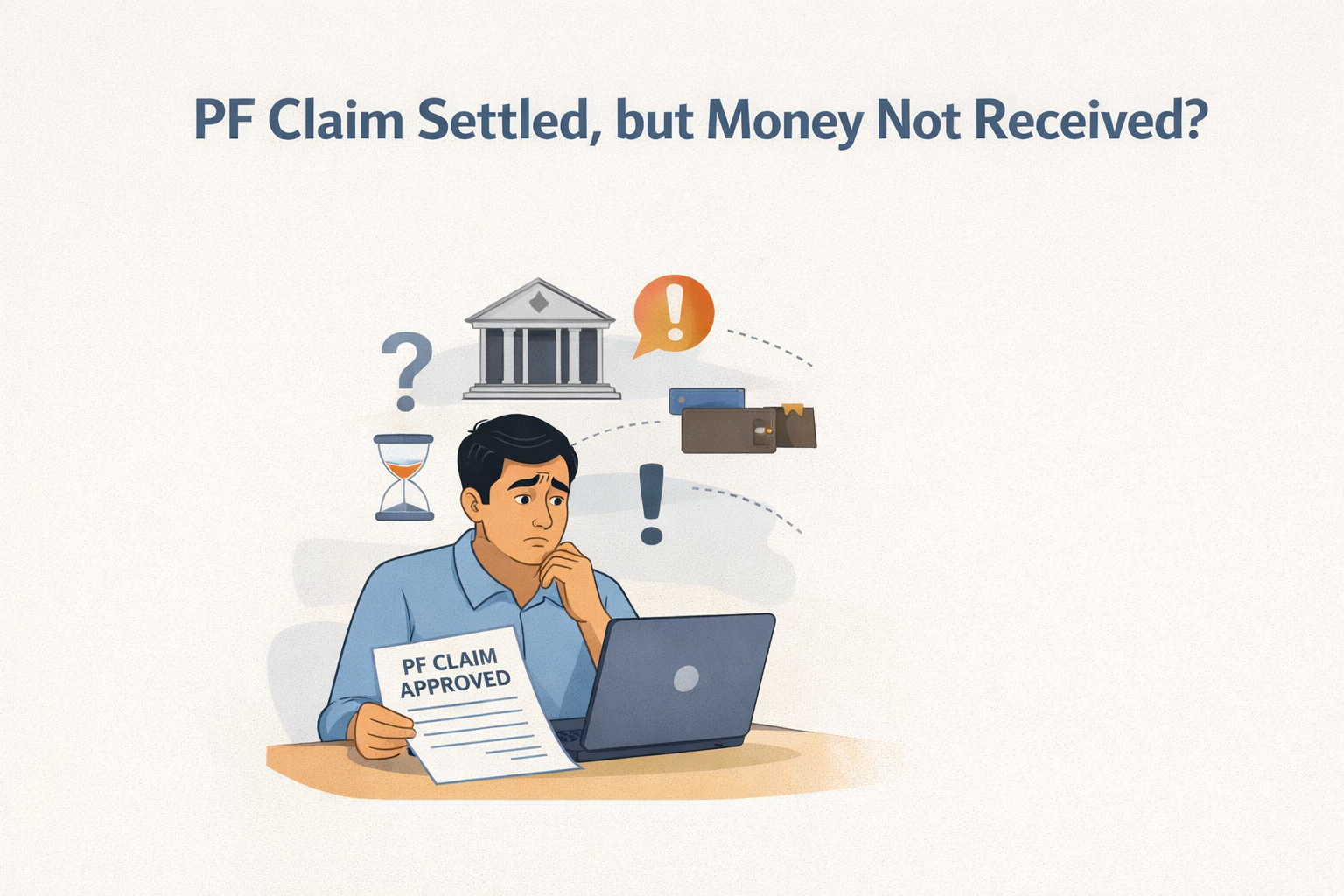
Before panicking, it is important to understand the EPFO terminology. When your dashboard displays "Claim Settled," it signifies that the EPFO Regional Office has completed the verification of your application.
Specifically:
- Your service history has been validated.
- The requested amount has been debited from your PF member account.
- A payment instruction (often via NEFT) has been generated and sent to the EPFO’s bank.
Important Note: "Settled" does not mean "Transferred." It means the EPFO has done its part and handed the baton to the banking system.
"Specifically, your service history has been validated, and the requested amount has been debited. If you are just starting this process, ensure you follow our comprehensive EPF Withdrawal Guide to avoid common filing errors that lead to delays later on."
Section 2: How Long PF Payments Normally Take
Under standard operating procedures in 2026, the timeline from settlement to credit has improved significantly. However, it is not instantaneous.
| Stage | Estimated Time |
| Claim Processing | 7–15 Working Days |
| Status Update to "Settled" | 24 Hours after approval |
| Bank Credit (NEFT/RTGS) | 3–5 Working Days |
If it has been fewer than three working days since your status changed to "Settled," the delay is likely due to standard banking transit time. If it has been more than 10 days, there is a high probability of a technical or clerical failure.
Section 3: Reasons PF Payments Fail or Money Not Received After Settlement
If your PF claim is settled but the bank did not receive money, the issue usually falls into one of these four categories:
3.1 Incorrect Bank Details (KYC Mismatch)
This is the most common culprit. Even if your KYC was "verified" by your employer, the bank might reject the incoming NEFT if:
- The IFSC Code is outdated (common after bank mergers).
- There is a minor typo in your Account Number.
- The Name on your PF account (e.g., Rajesh Kumar) doesn’t perfectly match the name on your bank records (e.g., Rajesh K).
"The Name on your PF account must perfectly match your bank records. For a detailed breakdown on how to fix name, DOB, or father's name errors, refer to our article on How to Handle EPF Mismatch Rejections."
3.2 Dormant or Inactive Bank Account
If you haven't used the bank account linked to your UAN for over six months, the bank may have marked it as "Dormant." Most banks will automatically reject incoming high-value NEFT transfers to dormant accounts as a security measure.
3.3 Account Type Restrictions
EPF credits must go into a Savings Account. If you mistakenly linked a Loan Account, an NRE/NRO account with specific restrictions, or a Jan Dhan account with a low credit limit (e.g., a ₹50,000 cap), the transaction will bounce.
3.4 Technical Errors at the Nodal Bank
Occasionally, the EPFO’s source bank experiences a server failure or a batch processing error. In these cases, the funds leave the EPFO but are held in a "suspense account" before being returned to the EPFO.
Section 4: How To Check PF Payment Status
Before lodging a formal complaint, verify the digital trail. You can track your payment through three primary channels:
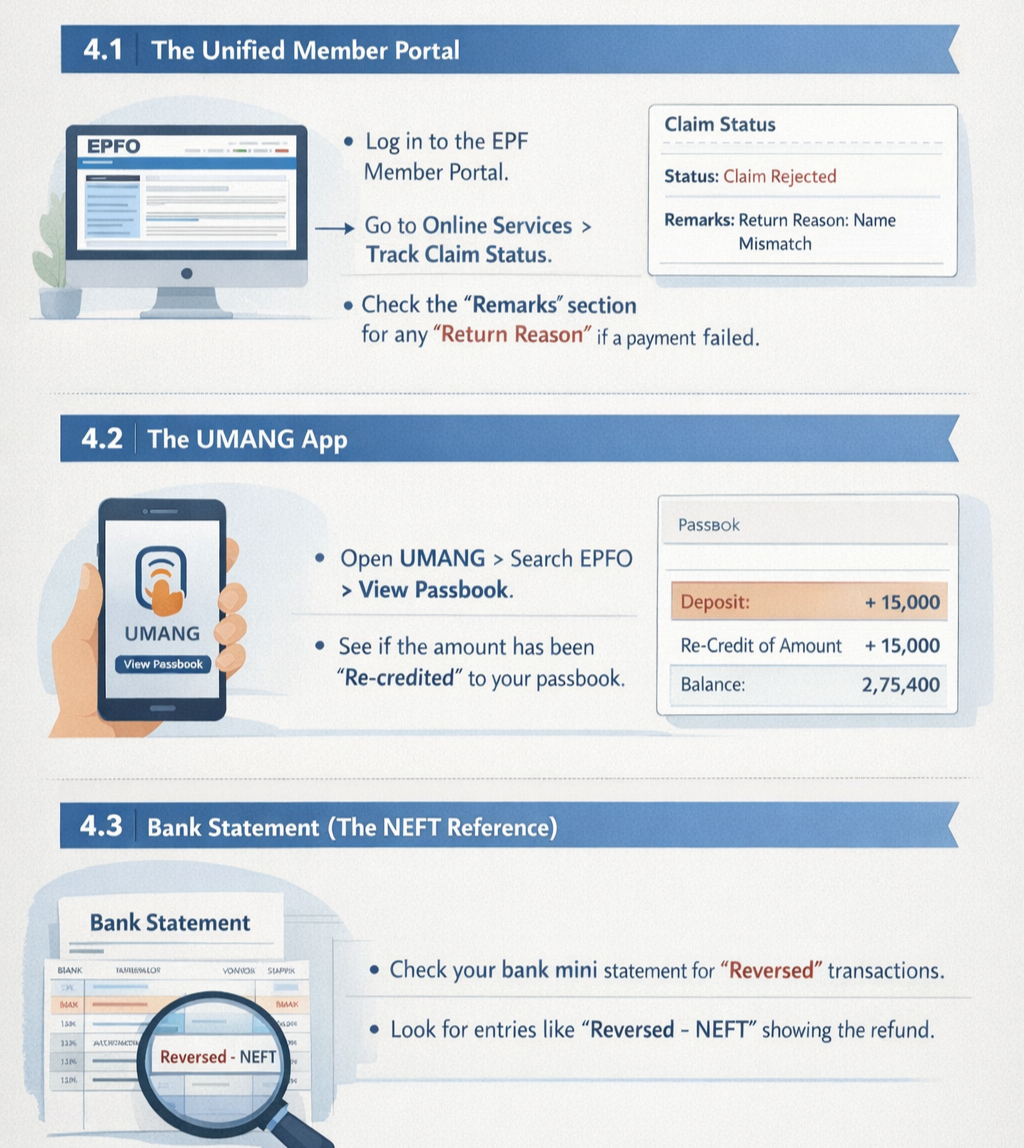
4.1 The Unified Member Portal
- Log in to the EPF Member Portal.
- Navigate to Online Services > Track Claim Status.
- Check the "Remarks" section. If a payment failed, it might eventually update here with a "Return Reason."
4.2 The UMANG App
The UMANG app is often more stable than the web portal.
- Open UMANG > Search EPFO > View Passbook.
- Check if the settled amount has been "Re-credited" to your passbook. If the payment fails, the money eventually flows back into your PF balance.
Section 4.3: Analysing Your Bank Statement (The NEFT/IMPS Trail)
Once the EPFO marks a claim as "Settled," the transaction moves into the banking network, typically via NEFT (National Electronic Funds Transfer). To confirm if the failure happened at your bank’s doorstep, you must look beyond your current balance and scrutinise your detailed transaction history.
How to Spot a "Failed Credit"
When a PF claim is settled, but the bank did not receive money, your statement might actually show a "ghost" transaction. Look for these specific indicators:
- The "Reversed" Transaction: In many cases, the money hits your account briefly, but the bank’s automated system detects a mismatch (like an incorrect name or an inactive account) and triggers an immediate "Reverse Sweep." You will see a credit followed by a debit of the same amount within seconds.
- The "Suspense Account" Hold: If your bank cannot find a matching account number, the funds may sit in the bank's internal "suspense account" for 24–48 hours before being bounced back to the EPFO's nodal bank.
- Transaction Remarks: Look for codes like "NEFT RET" (NEFT Returned) or "NPCI Return" in your mini-statement. This is definitive proof that the payment reached your bank but was rejected.
Pro Tip for Kustodian Life Readers:
If you see a reversal on your statement, do not wait for the EPFO to contact you. Take a screenshot or get a physical printout of that statement immediately. This document is the most powerful evidence you can attach when filing an EPF Technical Grievance to prove the settlement failed at the banking stage.
Section 5: How Failed PF Payments Are Reprocessed
If you have confirmed that your EPF payment failed after settlement, do not worry, the money is not "lost." It is currently in a state of limbo and will eventually return to the EPFO.
Here is the step-by-step recovery process:
5.1 Update Your KYC
If the failure was due to wrong bank details, you must first update your bank KYC on the UAN portal.
- Upload a cancelled cheque or bank passbook image clearly showing your name and the new IFSC.
- Get this approved by your employer.
5.2 The "Re-settlement" Auto-Process
In many cases, once the bank returns the money to the EPFO, the system identifies the failure. If you update your KYC promptly, the EPFO may attempt a repayment automatically. However, this is slow and unreliable.
5.3 File an EPF Grievance (The Fastest Way)
If the money isn't credited within 15 days of settlement, file a formal complaint at the EPFiGMS (EPF i-Grievance Management System).
- Go to epfigms.gov.in.
- Select "Register Grievance."
- Choose "PF Member" and enter your UAN.
- Under "Grievance Details," select the category "Settled but amount not credited."
- Upload a screenshot of your settled claim status and a copy of your bank statement showing no credit.
"Under 'Grievance Details,' select the category 'Settled but amount not credited.' For other technical issues like portal login errors or Annexure K problems, check our EPF Troubleshooting & Technical Grievance Article."
5.4 Submit a "Re-authorisation" Letter (Offline)
If the grievance portal doesn't resolve it, you may need to visit the Regional PF Office or send a registered post with a re-authorisation form. This is a manual request to the PF Commissioner to release the returned funds to your updated bank account.
Section 6: Why Trust Kustodian Life With Your Retirement Assets?
At Kustodian Life, we specialise in navigating the complexities of the Indian social security landscape. Our mission is to bridge the gap between government digital portals and the citizens who use them.
Managing retirement funds like EPF and NPS requires precision. We provide data-backed insights into the latest EPFO 3.0 updates, interest rate changes, and technical troubleshooting for UAN and Aadhaar integrations.
Whether you are dealing with an "Annexure K" rejection or simply tracking a settled claim, our resources are designed to ensure your transition into retirement is financially seamless and stress-free.
Is Your Money Stuck in a "System Gap"?
Even if your claim says "Settled," hidden KYC or banking mismatches can block the final credit. Don't wait weeks for a rejection.
- Identify Name & DOB Mismatches in under 2 minutes.
- Verify IFSC & Bank Account compatibility.
- Get a Step-by-Step Resolution Plan to fix your stuck payment.
Section 7: Frequently Asked Questions (FAQs)
To help you get fast answers, here are the most common queries regarding PF claims settled, but the amount was not credited.
1. How many days after "Claim Settled" will I get money in my bank?
Typically, it takes 3 to 5 working days for the amount to reflect in your bank account via NEFT. If there is a weekend or a bank holiday, this may extend to 7 days.
2. My status shows "Settled," but the money is not in my bank after 10 days. What should I do?
If 10 days have passed, check your EPF Passbook on the UMANG app. If the transaction failed, the money might have been "re-credited" to your account. If not, file a grievance at epfigms.gov.in immediately.
3. Can I get my PF amount in a joint bank account?
Yes, you can receive your PF credit in a joint account, but only if the second account holder is your spouse. If the joint account is with a parent or sibling, the bank may reject the payment.
4. Will I receive an SMS when the PF amount is credited?
You will usually receive two SMS alerts: one from the EPFO stating the claim is settled, and a second from your Bank when the amount is credited. If you only received the EPFO SMS, the banking transit is still in progress.
5. What is a "Re-authorisation Letter" for PF?
A re-authorisation letter is a physical document submitted to the Regional PF Commissioner when an online payment fails, and the money returns to the EPFO. It authorises them to send the funds to a corrected bank account.
Section 8: Conclusion: Staying Patient but Proactive
Seeing a PF claim approved, but the amount not credited, can be stressful, especially if you are counting on those funds for an emergency or a life milestone.
Summary Checklist:
- Wait at least 5 working days.
- Verify your IFSC code (especially if your bank merged recently).
- Check if your bank account is active.
- If 10 days pass, file a grievance on EPFiGMS.
At Kustodian Life, we aim to simplify your financial journey. Understanding the "why" behind these delays is the first step toward resolving them. Your money is safe; it’s just waiting for the right "address" to be delivered.
Disclaimer: This article is for informational purposes only and does not constitute legal or financial advice. Rules may vary based on individual records and EPFO processing.
![Why E-Khata Applications Get Rejected in Bangalore (And How to Fix Them) [2026]](/_next/image?url=https%3A%2F%2Fwebsite-assets-wix.s3.ap-south-1.amazonaws.com%2Fimages%2Fposts%2F3031ceb9f0274289aad5c5f140be716f.webp&w=828&q=75)