India’s most significant employment law overhaul in decades is officially here. Effective November 21, 2025, the government has consolidated 29 outdated laws into four comprehensive New Labour Codes covering wages, social security, industrial relations, and occupational safety.
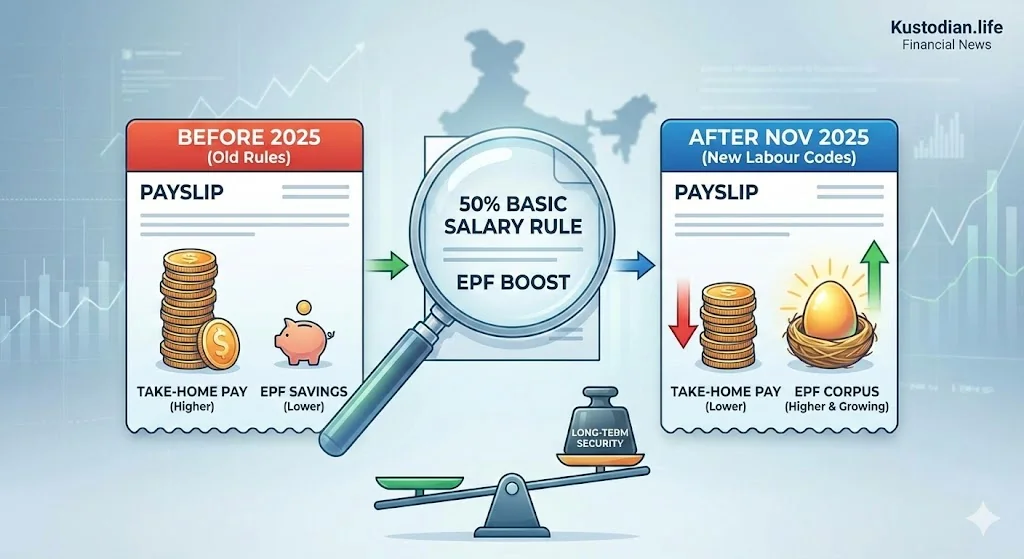
While the reforms aim to formalise the gig economy and simplify compliance for businesses, the immediate concern for millions of salaried employees is simple: Why has my monthly take-home pay decreased?
If your payslip looks different this month, it is likely due to the new "50% Basic Salary Rule." Here is a complete breakdown of how the New Labour Codes 2026 impact your EPF, Gratuity, and cash-in-hand.
EPFO Update: EPFO Holds Interest at 8.25% for FY 2025-26: A Win for Your Retirement Corpus
The 50% Basic Salary Rule: What Has Changed with Labour Codes 2026?
To understand the impact, you must look at how companies structure salaries.
- The Old Way: Employers often kept the "Basic Pay" component low (typically 25%–35% of the total CTC) and inflated "Allowances" to minimise their Provident Fund (PF) liability.
- The New Way (2026): Under the Code on Wages, the Basic Pay + Dearness Allowance (DA) must constitute at least 50% of your total Cost to Company (CTC).
- NOTE: The EPF Wage Ceiling (the mandatory limit) remains at ₹15,000 as per the 2026 Budget.
Why Does This Lower Your Take-Home Pay?
Your contribution to the Employees' Provident Fund (EPF) is calculated as 12% of your Basic Wage.
- Higher Basic Wage = Higher PF Contribution.
- Higher PF Contribution = More money locked in retirement savings.
- Result: Less cash in your bank account at the end of the month.
Salary Calculation: ₹80,000 CTC Example (Before vs. After)
Let’s look at a real-world scenario for a corporate employee with a monthly CTC of ₹80,000.
| Salary Component | 2025 Structure | New Labour Codes 2026 |
| Basic Salary | ₹25,000 (31% of CTC) | ₹40,000 (50% of CTC) |
| Allowances | ₹55,000 | ₹40,000 |
| Your EPF Contribution (12%) | ₹3,000 | ₹4,800 |
| Estimated Take-Home Pay | ~₹77,000 | ~₹75,200 |
The Verdict: In this example, the employee sees a monthly drop of ₹1,800 in disposable income.
The Silver Lining: Your Retirement Corpus
While the immediate drop hurts, the long-term gain is significant. Since your employer matches your contribution, an extra ₹3,600 (Employee + Employer share) is added to your EPF monthly.
- Annual Increase in Savings: ₹43,200
- Projected Growth (20 Years @ 8%): This forced saving could add an extra ₹20–₹30 Lakhs to your retirement fund.
Winners & Losers: Who is Impacted Most?
Not everyone will see a drastic change. Here is how different groups are affected:
- Low Basic Earners (<40% of CTC): Expect the sharpest drop in monthly cash flow. You may need to renegotiate your CTC to offset the difference.
- High Basic Earners: If your basic pay was already above 50% of your CTC, you will see minimal changes to your monthly slip.
- Gig & Contract Workers: The biggest winners. The new codes mandate social security benefits and pro-rata gratuity eligibility after just 1 year of service (down from 5 years).
- Women Employees: New provisions allow for night shifts across sectors, provided adequate safety and consent protocols are met.
Beyond Salary: Other Key EPFO Updates
The New Labour Codes aren't just about salary restructuring; they bring efficiency to the EPFO ecosystem:
- Faster Settlements: Companies are now required to settle "Full & Final" dues within 2 working days of an employee's exit.
- Universal Coverage: The social security net now extends to unorganized sectors, gig workers, and platform workers via a centralized Aadhaar-based database.
- Higher Gratuity: Since Gratuity is also calculated on the Basic Wage, your lump-sum payout upon leaving a job (after 5 years) will be significantly higher.
Read about all the latest EPF Rules 2026 in this sophisticated guide.
Useful Links & Official Resources
Official Government & EPFO Portals
- EPFO Official Website – Access official circulars, policy updates, and notifications related to EPF, EPS, and labour reforms.https://www.epfindia.gov.in
- EPFO Unified Member Portal – Log in with your UAN to check PF contributions, update KYC details, file claims, and track employer deposits.https://unifiedportal-mem.epfindia.gov.in/memberinterface/
- EPF Passbook Portal – View and download your EPF passbook with detailed monthly contribution records.https://passbook.epfindia.gov.in
- EPFO Claim Status Portal – Track the status of PF withdrawals or transfer requests.https://passbook.epfindia.gov.in/MemberPassBook/Login
Labour Codes & Policy Information
- Ministry of Labour & Employment – Official Website – Access official details about India’s Labour Codes, policy notifications, and compliance updates.https://labour.gov.in
- Code on Wages, 2019 (Official Act Document) – Learn about the legal framework behind the 50% wage rule and wage restructuring.https://labour.gov.in/sites/default/files/Code_on_Wages_2019.pdf
- Social Security Code, 2020 – Official documentation outlining new social security provisions for employees, gig workers, and platform workers.https://labour.gov.in/sites/default/files/TheCodeonSocialSecurity2020.pdf
Government Apps & Digital Services
- UMANG App – Access EPFO services like checking PF balance, filing claims, and tracking contributions directly from your mobile phone.https://umang.gov.in
- Jeevan Pramaan (Digital Life Certificate) – Pensioners can submit their life certificate online without visiting banks or EPFO offices.https://jeevanpramaan.gov.in
What Should You Do Now?
- Audit Your Payslip: Check if your Basic Pay has been adjusted to meet the 50% threshold.
- Track Contributions: Log in to the EPFO portal to ensure the increased deductions are being credited correctly.
- Adjust Your Budget: If you are facing a cash crunch due to the dip, review your monthly expenses immediately.
- Recover Old Funds: With EPF becoming a larger part of your wealth, ensure you don't have lost accounts from previous jobs.
If you are confused, take a free EPF consultation with Kustodian to settle your doubts.
FAQs
1. What is the 50% basic salary rule under the new labour codes?
The 50% basic salary rule requires that the basic pay plus dearness allowance (DA) must constitute at least 50% of an employee’s total Cost to Company (CTC). Earlier, many employers kept the basic salary lower and increased allowances to reduce EPF and gratuity contributions. The new rule standardizes salary structures and increases retirement benefits.
2. Why has my take-home salary decreased after the labour code changes?
Your take-home salary may decrease because EPF contributions are calculated as 12% of your basic salary. Since the new labour codes increase the basic salary component to at least 50% of CTC, the PF deduction becomes higher, which slightly reduces your monthly cash-in-hand salary.
3. Does the employer also contribute more to EPF under the new rules?
Yes. Employers must contribute 12% of the employee’s basic salary to EPF, matching the employee’s contribution. With a higher basic salary under the new wage structure, both employee and employer contributions increase, which boosts your long-term retirement savings.
4. What is the EPF wage ceiling in 2026?
As of 2026, the statutory EPF wage ceiling remains ₹15,000 per month for mandatory contributions under the Employees’ Provident Fund Scheme. However, employers may voluntarily contribute on higher wages depending on company policy.
5. Will the new labour codes affect gratuity payments?
Yes. Gratuity is calculated based on the basic salary plus dearness allowance. Since the new labour codes increase the basic component, employees may receive higher gratuity payouts when leaving a job after completing the required service period.
6. Who benefits the most from the new labour codes?
The biggest beneficiaries include:
- Gig and platform workers, who now gain access to social security benefits
- Contract workers, who may become eligible for gratuity earlier
- Employees with low basic salary structures, who will accumulate higher retirement savings through EPF and gratuity.
7. Will all employees see a reduction in take-home salary?
Not necessarily. Employees whose basic salary was already 50% or more of their CTC will likely see little or no change in their take-home salary. The biggest impact will be on employees whose companies previously structured salaries with a low basic pay and high allowances.
8. Can companies restructure salaries to avoid the 50% rule?
No. The Code on Wages mandates that basic salary plus DA must be at least 50% of total remuneration. If allowances exceed 50%, the excess amount is treated as part of wages for calculating benefits such as EPF and gratuity.
9. How can I verify whether my employer is depositing my EPF contributions correctly?
You can verify your EPF contributions by logging into the EPFO Unified Member Portal and downloading your EPF passbook, which shows month-wise contributions from both you and your employer.
10. What should I do if my EPF deductions increase but the employer contribution does not?
If you notice discrepancies between your salary slip and EPF passbook, you should first raise the issue with your HR or payroll team. If the issue persists, you can file a grievance through the EPFO grievance portal to investigate the matter.
11. Are gig workers and freelancers now covered under EPF?
The new labour codes expand social security coverage to gig workers, platform workers, and certain contract workers. However, the implementation depends on employer registration and compliance with the new social security framework.
12. Is the reduction in take-home salary permanent?
The reduction in take-home salary is not exactly a loss; it is a shift toward higher retirement savings. The additional PF contributions accumulate over time and earn interest, potentially resulting in a significantly larger retirement corpus.
Final Thought: The New Labour Codes 2026 may feel like "short-term pain" for your wallet, but experts agree they provide "long-term gain" for your financial security.
Note for Families: If you are dealing with legacy financial issues or unclaimed EPF accounts after the loss of a loved one, tools like Kustodian.life can help simplify the recovery process.
![Why E-Khata Applications Get Rejected in Bangalore (And How to Fix Them) [2026]](/_next/image?url=https%3A%2F%2Fwebsite-assets-wix.s3.ap-south-1.amazonaws.com%2Fimages%2Fposts%2F3031ceb9f0274289aad5c5f140be716f.webp&w=828&q=75)